Inside the Factory: The Complete 11-Step Trail Camera Manufacturing Process
September 11, 2026 ︱ By Willfine
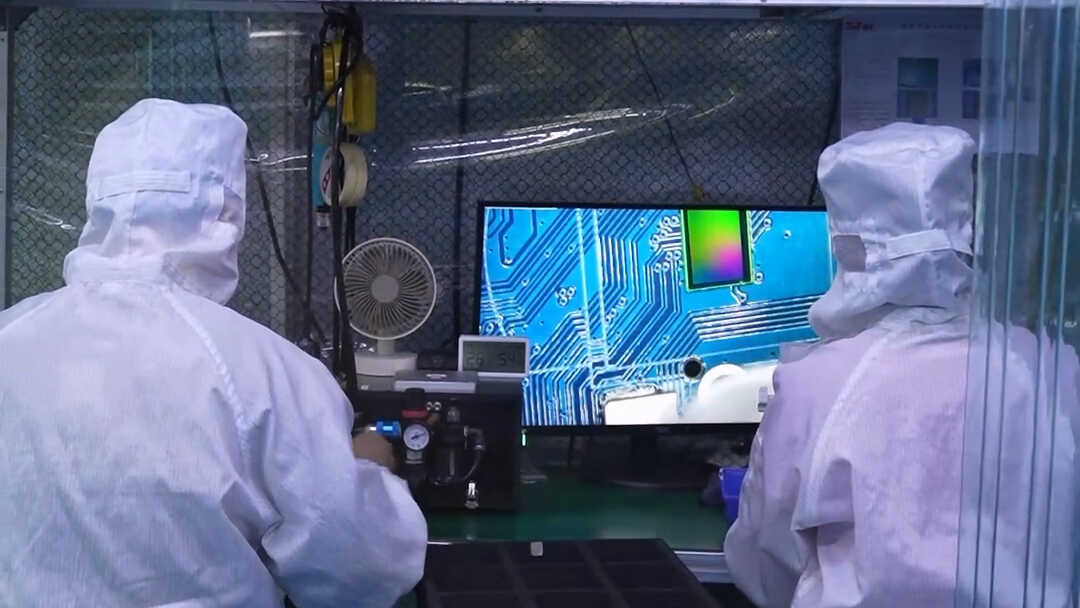
1.Sensor Cleaning — The Line Between Premium and Cheap
Summary: The image sensor is the heart of any trail camera. Incomplete cleaning means a permanent dark spot in every night shot — and a returned product. This step is what separates a premium factory from a cheap assembly shop.
The Action
On an ESD-safe, controlled workbench, technicians use ionized air guns and specialized optical cleaning tools to precision-clean the surface of the CMOS image sensor. Every sensor is then visually inspected under magnification to ensure zero dust, zero fingerprints, and zero fiber residue. For Sony STARVIS series sensors, we add an extra layer of MSL (Moisture Sensitivity Level) control — exposure time from unpacking to assembly must not exceed 4 hours.
Why it matters for trail cameras
A trail camera’s working environment means it relies heavily on nighttime capture. A single speck of dust on the sensor may be invisible in daylight, but once the 940nm no-glow IR补光 kicks in, it projects as a fixed dark spot in the center of every frame — something no software can repair. This is why two factories can use the same Sony sensor and still deliver drastically different night image quality.
Common failure mode
Incomplete cleaning leads to concentrated dead pixels → the Amazon review keyword “black spots on night vision” → batch returns. Worse still, dust carbonizes during high-temperature burn-in and becomes a permanent defect beyond warranty coverage.
What to look for during your audit
Walk up to the cleaning station and ask three questions: (1) Is there an ionizer and ESD wrist straps? (2) What magnification is used, and is there an inspection record? (3) How is sensor exposure time from unpacking to placement controlled? If they cannot answer, downgrade immediately.
Industry shortcut vs. Willfine
Traders and Tier 2 assembly shops usually skip this step — the sensor goes straight from the supplier onto the tester. We clean every sensor in a controlled environment with magnification inspection and MSL timing control. It is the baseline operation behind 20 years of Willfine manufacturing.

2.Lens Focus Adjustment — Accuracy Down to the Millimeter
Summary: A 1mm focus error means a blurry target at 10 meters. We use an ISO12233 resolution chart plus software to verify sharpness across the entire frame, with technicians making sub-millimeter adjustments and locking the focus ring with a torque wrench on every unit.
The Action
After the lens is threaded into the lens mount, the technician adjusts the focus in a darkroom using an ISO12233 resolution test chart, with software reading the MTF (Modulation Transfer Function) values in real time to ensure center-to-corner resolution meets spec. Once the optimal focus is confirmed, a preset-torque wrench locks the focus ring to prevent drift during shipping vibration.
Why it matters for trail cameras
Trail cameras are typically mounted at distances of 5–25 meters. A 1mm focus error means a claimed 4K resolution delivers only 1080p real-world detail at 10 meters. More critically, the focus point must align with the Fresnel lens PIR detection zone — if the lens focus and the Fresnel sensing area are misaligned, you get the awkward “detected but not captured” scenario.
Common failure mode
No torque lock → the focus ring rotates during transit → the user’s first photo out of the box is soft → the review “blurry out of the box” → DOA returns.
What to look for during your audit
Ask the line leader to demo the focusing process. Watch for three things: (1) Is there a resolution chart and software readout? (2) What is the preset torque value, and is the wrench calibrated? (3) Pull 3 random finished units and check focus consistency — deviation over 0.05mm signals an unstable process.
Industry shortcut vs. Willfine
Small shops eyeball it — “looks sharp enough, lock it down” — with no torque lock. We run every unit through a resolution chart plus software verification plus torque locking, with batch MTF consistency sampling.

3.Semi-finished Display — A Look Inside the Build
Summary: PCB layout, IR LED array solder joints, internal wiring — these details are permanently hidden once the housing is sealed, yet they determine whether the camera survives years in the field.
The Action
Semi-finished products at various assembly stages are laid out on anti-static carts, displaying the complete internal architecture: the main PCB (with low-power SoC and Edge-AI NPU), lens module, CMOS sensor, 940nm IR LED array, PIR analog front-end, battery contact points, and antenna routing.
Why it matters for trail cameras
A trail camera runs on battery power, so every trace on the PCB affects standby current. A poorly designed power domain can cut a claimed 6-month battery life down to 8 weeks. The solder joint quality of the IR LED array determines both night range and illumination uniformity. None of this is visible from the outside — only by opening it up can you judge the factory’s engineering capability.
What to look for during your audit
Check three points directly: (1) Is the PCB routing clean, with no jumper wires? (2) Are the 940nm LED solder joints forming a proper crescent shape? (3) Are the battery contacts solid copper with gold plating? If you see jumpers or signs of hand-rework, the design is not mature.
4.Shell Assembly (Dust-free Tent) — The First Line of IP66 Defense
Summary: Dust-free tent plus positive-pressure airflow, gaskets, and ultrasonic welding on select models. Internal cleanliness and sealing quality directly determine waterproof service life.

The Action
Inside a Class-10,000 clean tent, the operator first installs the breathable waterproof membrane (e-PTFE material, balancing internal and external air pressure while blocking water molecules), then seats the silicone gasket. Selected high-end models use ultrasonic welding to molecularly fuse the front and rear shells into a permanent bond. Finally, stainless steel screws are torqued to a preset value.
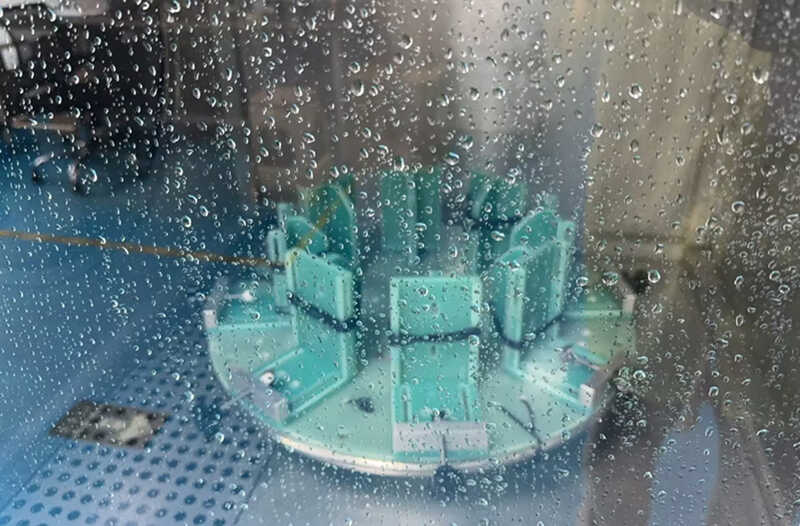
Why it matters for trail cameras
A trail camera hangs on a tree, exposed to sun, rain, and daily temperature swings. Dust inside the shell drives up thermal noise; a poor seal lets rainwater in and corrodes the mainboard. Ultrasonic-welded models withstand −30°C to 60°C thermal expansion cycles without cracking — something screw-only assemblies cannot match.
Common failure mode
Insufficient gasket compression → water collects inside after spraying → mainboard shorts → the review “stopped working after rain” → brand rating collapses in Q4.
What to look for during your audit
Inside the clean tent, check three things: (1) Is the positive-pressure air supply running? (2) What do the temperature and humidity readings say? (3) What are the ultrasonic welding parameters and first-article records? A factory willing to show you a welded cross-section has confidence in its process.
Industry shortcut vs. Willfine
Ordinary assembly shops build shells in open workstations, relying on a silicone gasket plus screws. We operate inside a clean tent, and our high-end models add ultrasonic welding — reliability stepped up by an entire level.
5.4G Cellular Testing — Staying Connected in Remote Areas
Summary: Every 4G unit is tested for signal acquisition, transmission speed, and auto-reconnect. A shielded box simulates weak-signal field conditions to ensure reliable image delivery from remote hunting grounds.
The Action
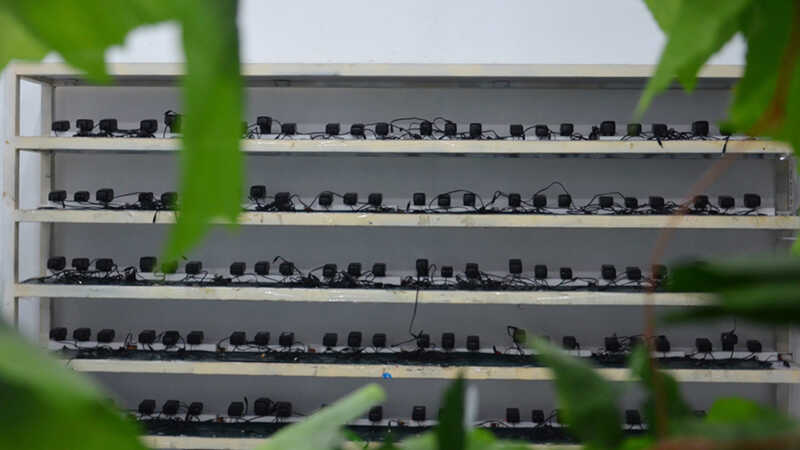
After inserting a SIM card or activating the eSIM, the camera is placed in a shielded box and tested across the LTE Cat-1 bands (B1/B3/B5/B7/B8/B20/B28, etc., configured for the target market) for network registration, FTP/SMTP image transmission, MQTT heartbeat maintenance, and automatic reconnection after disconnection. Testing covers signal levels as low as −105dBm.
Why it matters for trail cameras
The core value of a 4G trail camera is remote image delivery. Buyers deploy them in remote hunting grounds or farms where signal strength naturally fluctuates. If the camera cannot auto-reconnect, the user may not notice for weeks — and the game is long gone. Willfine 4G models maintain a heartbeat even at −110dBm extreme weak signal, automatically resending once the signal recovers.
Common failure mode
Failing the shielded-box test → frequent dropouts in real deployment → the review “won’t stay connected” → high return rates.
What to look for during your audit
Check whether the 4G station has a comprehensive tester and a shielded box. If the factory says “we just pop in a phone SIM and see if it works,” it has no real RF testing capability.
Industry shortcut vs. Willfine
Small shops test against the outside signal — everything passes when reception is good and fails when it is weak. We use a shielded box to simulate every band plus attenuation scenarios, covering all major global carrier frequencies.
6.Waterproof Testing — Live Demonstration With a Pressure Washer
Summary: IP66 means completely dust-tight and protected against powerful water jets. We use a real high-pressure washer spraying from every angle — demonstrated live.
The Action
Finished units are moved to the IP66 spray test area and blasted with a pressure washer at 100L/min from distances of 2.5–3 meters, spraying from all six directions (top, bottom, left, right, front, back) for over 3 minutes. After the test, the housing is opened to check for any water ingress. Selected batches also undergo pressure decay leak detection — the unit is placed in a sealed chamber, pressurized, and the pressure drop curve is monitored over time.
Why it matters for trail cameras
An IP rating is not a sticker — it is the camera’s survival guarantee in rainforests, snowstorms, and next to garden sprinklers. Pressure decay testing catches micro-leaks invisible to the naked eye, making it more reliable than a simple spray test.
Common failure mode
An undetected micro-leak → internal condensation after 2 months in the field → circuit corrosion → concentrated winter repairs.
What to look for during your audit
Ask the factory to demo the spray test on the spot. A factory willing to blast the camera with a pressure washer in front of you is a factory willing to stand behind its waterproof claim. Also ask about pressure decay equipment — it is standard for Tier 3 manufacturers.
Industry shortcut vs. Willfine
Some apply an IP66 sticker with no real testing → we run every unit (or batch) through high-pressure spray plus pressure decay leak detection, double insured.
7.Aging Test — 100% Full Inspection, Compressing Months Into Hours
Summary: Every camera runs continuously for 72 hours at 55°C, cycling through PIR triggers, photo capture, and 4G transmission. 100% full inspection screens out marginal pass units.
The Action
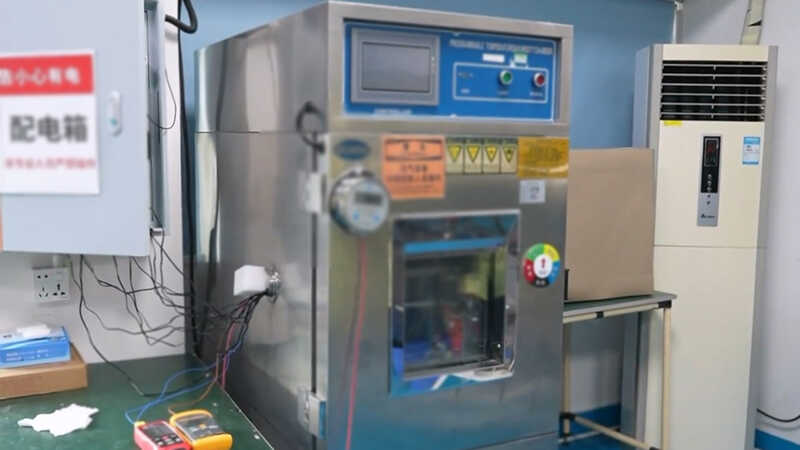
Every finished unit enters the high-temperature aging rack, powered on continuously for 72 hours at 55°C. During this period, the system automatically cycles through: PIR trigger → daytime photo → 940nm night shot → 4G upload → sleep → trigger again — simulating months of real field load.
Why it matters for trail cameras
Aging catches marginal pass units — the ones that power on but have a weak solder joint or a borderline component that will fail on day 30 in the field. Our DOA (Dead On Arrival) rate stays below 0.5%, built on the back of those 72 hours.
Common failure mode
Skipping aging or running a room-temperature idle → marginal cold solder joints reach the market → the user’s screen goes white on day 30 at 2 a.m. → after-sales cost dwarfs the aging electricity bill.
What to look for during your audit
Check three hard metrics at the aging area: (1) Is it 100% full inspection or sampling? (2) Is there a real-time temperature logger? (3) Does the aging program cycle through triggers, or does it just sit powered on? Powered on with no triggering = no real aging.
Industry shortcut vs. Willfine
10% sampling plus 24h at room temperature → we do 100% full inspection, 72h at 55°C, with a full functional cycle load.
8.Photo Test — Trigger Speed, Night Vision & Full Image Quality
Summary: Standard gray card plus distance scale — measuring trigger speed (target ≤0.2s), recovery time, 940nm night shot uniformity, and color accuracy.
The Action
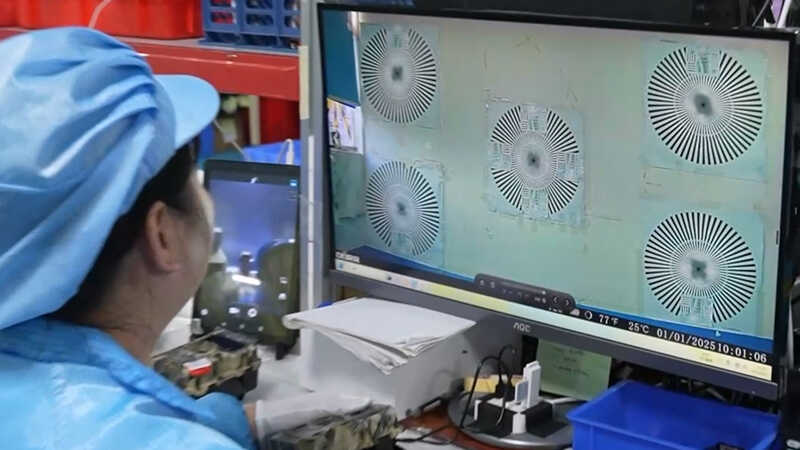
In a darkroom, standardized lighting conditions and a gray card establish the test setup. Triggering the PIR sensor records the time from heat detection to first photo (trigger speed). Continuous shooting then measures recovery time (the interval between successive shots). Switching to 940nm IR mode checks illumination uniformity and effective range.
Why it matters for trail cameras
A hunting window is extremely short — a deer stepping out from behind a tree may be visible for only one second. A 0.1s slower trigger means a missed shot. The advantage of 940nm no-glow is stealth, but if the LED array layout is uneven, the frame shows center overexposure with dark corners.
Common failure mode
Overstated trigger speed → the user measures 0.5s+ in real use → the review “misses the shot” → returns.
What to look for during your audit
Ask the factory to test one unit on the spot. Use a stopwatch or high-speed camera to time the interval from waving a hand past the PIR window to the flash firing. Also check the night sample — uniformity is obvious to the eye.
Industry shortcut vs. Willfine
Small shops eyeball it — “it captured something, good enough” → we use a standard gray card, distance scale, and timer, with objective records for trigger speed and recovery time.

9.Final Outgoing Quality Control (OQC) — Zero Defects Leave the Line
Summary: 100% final inspection of appearance, function, waterproofing, labeling, and accessories. Defective units are isolated and traced back to the root cause at the specific process step.
The Action
Every unit that passed the earlier stages moves to the OQC (Outgoing Quality Control) station. Inspectors work through a checklist at AQL Level II:housing scratches and color deviation, button feel, LED indicators, SD card read/write, gasket integrity, label print accuracy, and accessory completeness (straps, mounts, manuals, batteries). Defective units go into a red isolation bin; the system logs the defect code and traces it back to the responsible process step.
Why it matters for trail cameras
The most common 1–2 star reviews on Amazon for trail cameras are not hardware failures — they are “scratch on the housing,” “missing a strap,” “manual is in Chinese.” These preventable errors are 100% preventable through OQC.
Common failure mode
Too-low sampling rate or fatigued inspectors → defective units reach the FBA warehouse → bad reviews → rating drops → ad weight falls.
What to look for during your audit
Check whether the OQC station has an inspection guide and a defect sample reference board. Ask how defects are handled — a factory that can answer “isolate → log → trace to root cause → corrective and preventive action” has a sound system.
Industry shortcut vs. Willfine
Small shops sample 5% or skip it entirely → we do 100% full inspection with defect tracing and a closed-loop corrective and preventive action process.
10.Barcode Printing — Full Traceability From Raw Material to Finished Product
Summary: Each camera gets a unique serial number linking component batches, test records, and production date. After-sales issues become traceable, and order fulfillment stays accurate.
The Action
Before entering the packaging line, the system auto-generates a unique SN barcode (4G models also include the IMEI/MEID), which is printed and applied at the designated spot on the housing. The barcode data is written into the MES system, linking this unit’s sensor batch, PCB batch, aging record, and test results.
Why it matters for trail cameras
When a repair unit comes in, scanning the SN instantly reveals its full history — production date, Sony sensor batch, any anomalies during aging. This compresses after-sales response time from days to minutes.
What to look for during your audit
Ask: can the barcode system trace back to the component batch? If it only goes back to the production date, the MES depth is insufficient. The ability to trace to the chip-level batch indicates mature supply chain management.

11.Scanning — The Final Stock-check Gate Before Shipment
Summary: Before packaging, the SN is scanned to confirm the model, configuration, and accessories all match the order. Inventory is updated in real time, and the product moves from WIP to Finished Goods.
The Action
At the packaging station, the barcode is scanned and the system automatically verifies: correct model, configuration matching the order, and complete accessories. Once verified, the product status flips from WIP (Work In Progress) to Finished Goods, the inventory system deducts the available quantity in real time, and a picking list is generated.
Why it matters for trail cameras
Trail cameras have many SKUs — the same housing may come in 4G or non-4G, 8MP/12MP/4K, 940nm/850nm variants. Scan-based mistake-proofing ensures you never ship an 850nm red-glow version to a client who ordered no-glow.
What to look for during your audit
Check whether the scanning station has mistake-proof alarms — does the system automatically block and beep when the wrong model is scanned? No alarm = pure manual checking = a wrong shipment is only a matter of time.
Appendix: The 11-Station Factory Audit Scorecard (Print & Bring Along)
| Station | Checkpoint | Pass Criteria | Score |
|---|---|---|---|
| 1 | Sensor Cleaning | Ionizer + magnification inspection + MSL control | |
| 2 | Lens Focus | Test chart + software readout + torque lock | |
| 3 | Semi-finished | No jumpers,full solder joints, clean routing | |
| 4 | Shell Assembly | Clean tent + positive pressure + ultrasonic welding (high-end) | |
| 5 | 4G Testing | Shielded box + multi-band + weak-signal simulation + auto-reconnect | |
| 6 | Waterproof | Pressure washer demo + pressure decay leak detector | |
| 7 | Aging | 100% full inspection + 55°C + 72h + cycling triggers | |
| 8 | Photo Test | Gray card + timer for trigger speed | |
| 9 | OQC | 100% full inspection + defect isolation + root-cause tracing | |
| 10 | Barcode | Unique SN + MES linked to component batches | |
| 11 | Scanning | System mistake-proofing + wrong-scan alarm |
Frequently Asked Questions (Buying Decisions FAQ)
Q: What is the MOQ for trail cameras? How does white-label MOQ differ from private mold ODM?
A: White-label runs on a low-volume launch tier (small batch, existing platform, your logo + packaging). Private-mold ODM sits on a tooling-backed tier — higher entry volume, exclusive shell, full BOM control. We don’t publish one flat MOQ because it moves with model + customization depth — share your target market and we’ll bracket it.
Q: What is the typical lead time?
A: Standard white-label configuration runs 15–20 days. Firmware customization or private mold work runs 30–45 days. 4G models need extra time for carrier certification. We support split shipments, with the first batch available to meet your launch window.
Q: Is waterproof testing done on every unit or by sampling? What is the difference between IP66 and IP67?
A: We use batch sampling plus pressure decay leak detection. For key client orders, we can pressure-spray every unit. IP66 protects against powerful water jets; IP67 adds short-term immersion. For a trail camera hanging outdoors, IP66 is sufficient — choose IP67 for immersion scenarios.
Q: Is the aging test really 100% full inspection? At what temperature?
A: Yes. Every Willfine camera undergoes a full 72-hour, 55°C functional cycle burn-in. This is our baseline standard, not an optional service.
Q: Which bands do the 4G models support? Which countries are covered?
A: Full LTE Cat-1 band coverage (B1/B3/B5/B7/B8/B20/B28, etc.), supporting major carriers across North America, Europe, and Asia-Pacific. The factory flashes the correct band configuration for the target market to avoid network lock issues.
Q: What is the difference between 940nm no-glow and 850nm? Which is better for hunting?
A: 940nm no-glow is invisible to the human eye, offering maximum stealth — perfect for hunting. 850nm has a faint red glow but delivers longer night range and brighter images. Willfine’s hunting lineup defaults to 940nm; some farm security models offer 850nm as an option.
Q: Which models use ultrasonic welding? Does it add cost?
A: Ultrasonic welding is used on selected high-end models for a molecularly permanent shell seal. It costs about 8–12% more than screw-only assembly, but extends waterproof service life from 2 years to over 5. Recommended for long-term outdoor deployments.
Q: What certifications do the products have? What compliance is needed for exporting to the US and EU?
A: The full Willfine lineup is certified for FCC (USA), CE-RED (Europe), and RoHS. 4G models additionally carry PTCRB/GCF certification. We provide complete compliance documentation to support your Amazon listing approval process.
Get the Complete “11-Station Factory Audit Checklist”
Leave us your email and we will send the PDF checklist along with the TA200S Edge-AI BOM delta sheet and the current month’s capacity schedule.
CONTACT US FOR OEM/ODM CAMERAS
- >>G100 RV Dealership Perimeter Plan | 4G Off-Grid Security Camera for RV Lots
- >>White-Label 4G Off-Grid Cameras vs Consumer RV Cameras for Rental Fleets
- >>How to Choose a Trail Camera Lens? Focal Length, FOV & Real-World Scenarios Explained
- >>Buyer's Factory Audit Manual: How to Audit a Chinese Trail Camera OEM/ODM Factory
- >>SPYPOINT / Moultrie / Bushnell / Browning vs. Willfine: Trail Camera Architecture Teardown for OEM Buyers