SPYPOINT / Moultrie / Bushnell / Browning vs. Willfine: Trail Camera Architecture Teardown for OEM Buyers
September 23, 2026 ︱ By Willfine
Why “Higher Megapixels” Is the Wrong Sales Pitch
Most trail camera marketing is a spec war fought on the wrong battlefield: higher resolution, longer flash range, faster trigger speed on paper. None of these numbers explain why one platform succeeds in a private-label program while another costs the buyer an entire season in returns.
A B2B architecture comparison must answer a different question: When a leaf moves, can the camera tell the difference — and who pays for the mistake?
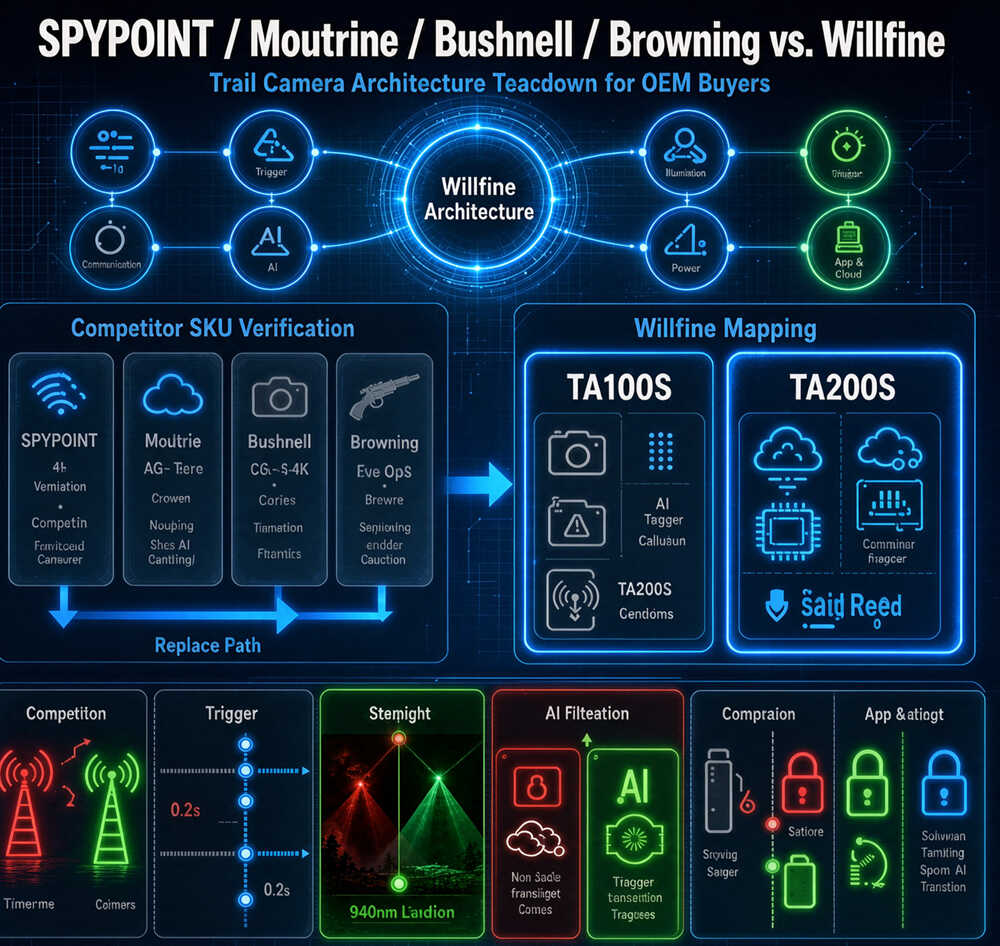
1. Competitor SKU Verification (Official / High-Authority Sources, Embedded)
| Competitor | Official Live SKU / Series | Key Facts (Verified) | Correction to Original Description |
|---|---|---|---|
| SPYPOINT Flex-S-Dark | SPYPOINT FLEX-S-DARK (SKU 01811) | 4G Dual-SIM cross-carrier, 40MP, 1080p, Low-Glow/No-Glow LED switchable, built-in solar + lithium battery, BUCK TRACKER AI, 100 free photos/month, app-side filtering after upload | Not “pure cloud AI with no AI at all” — correct phrasing: “APP-side AI classification + upload-then-filter, no on-device model” |
| Moultrie Edge 3 Pro | Moultrie EDGE 3 PRO (MMC-14204) | 4G multi-carrier Auto-Connect, Moultrie AI, 50MP, 1440p, No-Glow, 0.3s, GPS, internal memory, tightly bound to Moultrie App | AI sits at cloud/account level; brand owners cannot white-label Moultrie AI |
| Bushnell Core S-4K | Bushnell CORE S-4K No Glow (119949C) | Non-Cellular, 4K video, 30MP, No-Glow 110ft, 0.2s, US region-locked, SD card storage | High-end image quality unit, but no 4G, no AI, no remote transmission |
| Browning Dark Ops | Browning Dark Ops FHDR (BTC-6FHDR) | Non-Cellular, 940nm No-Glow, 0.135–0.7s trigger, 26/40MP, HDR night capture, SD card | Should be written as “Dark Ops FHDR series,” not a single vague model name |
Verification conclusion: All four mapping directions hold, but sales materials must NOT claim “competitors all have edge AI.” The correct statement is: SPYPOINT / Moultrie = cellular + cloud/account-level AI; Bushnell / Browning = non-cellular premium, no remote, no edge AI.
2. The Six Dimensions That Actually Matter
2.1 Communication Architecture: Legacy RF vs. LTE Cat.1 / Cat.1bis
The dividing line is not “cellular or not.” It is whether the radio can still attach to a live network. 2G/3G has been decommissioned in North America and is being phased out across Europe. Modern platforms use LTE Cat.1 / Cat.1bis with separate US and EU SKUs.
Region × Frequency Band × Carrier Deployment Reference Table
| Region Version | Module Tech Architecture | Mainstream FDD-LTE Bands | Primary Carriers / Regions Covered | Deployment Notes |
|---|---|---|---|---|
| North America | LTE Cat.1 / Cat.1bis (dual-antenna / single-antenna) | B2 / B4 / B5 / B12 / B13 / B14 / B25 / B26 / B66 / B71 | AT&T (B2/B4/B12), Verizon (B4/B13), T-Mobile (B2/B4/B12/B71) | Requires FCC / PTCRB certification. Priority coverage of low bands (B12/B13/B71) for forest penetration |
| Europe & APAC | LTE Cat.1bis (single-antenna ultra-cost) | B1 / B3 / B5 / B7 / B8 / B20 / B28 | Vodafone, Deutsche Telekom, Orange, Telefonica (O2), EE | Compliant with CE / RED. B20 (800 MHz) and B28 (700 MHz) are the core golden bands for remote rural and wild-area coverage in Europe |
The real benchmark question is not “Does it have 4G?” — it is “Which bands, which SKU, for which country?”
Figures below are compiled from publicly available manufacturer pages and distributor listings as of 2026-09. TA100S US bands are listed as B2/B4/B5/B12/B13; TA200S adds B66. Regional SKU configurations may change — if anything is outdated, corrections are welcome.
2.2 Trigger: What Is That Number Actually Measuring?
“0.2s / 0.3s” could mean:
- PIR wake to shutter release, OR
- Motion to first thumbnail transmitted
A credible benchmark should report:
- PIR wake time from standby
- Time from wake to first frame captured
- Time from capture to thumbnail transmitted
- Performance at −20°C and +55°C
2.3 Illumination: No-Glow Is an Operational Feature, Not a Marketing Phrase
| Specification | What to Verify |
|---|---|
| 850 nm (visible glow) | Visible red dot at night; increases animal alertness and theft risk |
| 940 nm (no-glow) | Completely invisible, but uniformity and effective range require field validation |
| 54× 940 nm LEDs | Hardware baseline; actual performance depends on reflector cup design and power distribution |
2.4 AI Filtering: Cloud/Account-Level vs. On-Chip Edge
| Approach | How It Works | What It Means for the OEM Buyer |
|---|---|---|
| No AI / PIR only | Any temperature change triggers | Highest false-trigger rate; maximum SIM traffic waste |
| Cloud / APP AI (SPYPOINT, Moultrie) | Image uploads first, then classified server-side or at account level | Intelligent, but non-target events already consumed traffic and power |
| On-device chip AI (TA200S) | Camera chip recognizes 30+ species; non-targets never transmit | False triggers blocked at hardware layer; traffic and battery far more controllable |
Based on public Willfine materials and typical deployment assumptions. Actual savings vary by site, PIR sensitivity, species mix, and upload policy.
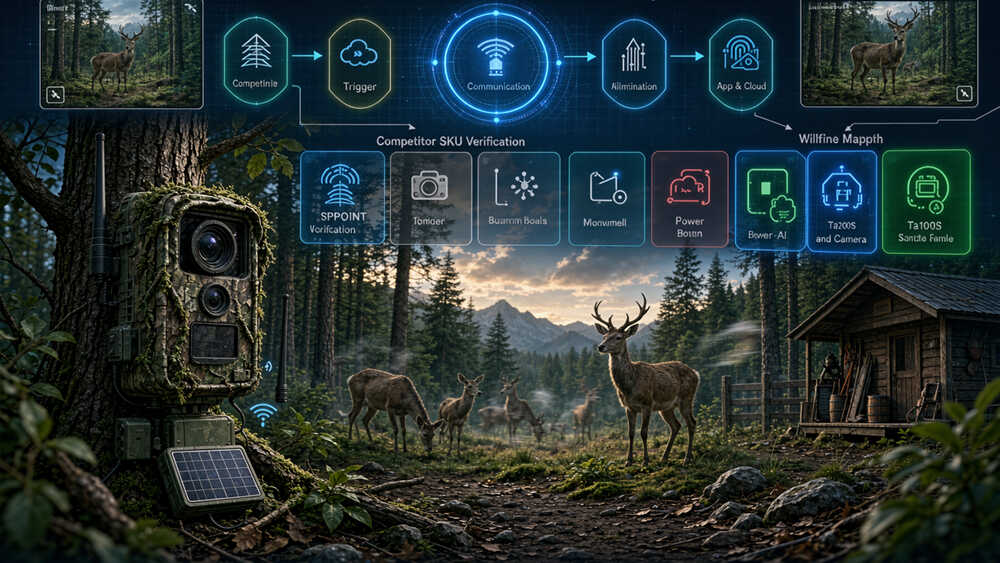
2.5 Power & Battery Life: Paper Numbers vs. Real Scenarios
- “6-month standby” must be qualified by: temperature, number of captures, whether live streaming is enabled, battery chemistry
- “Solar compatible” must distinguish: native low-power design vs. bolt-on panel
- Alkaline vs. lithium performance diverges sharply at −20°C; both must be rated separately
2.6 App & Cloud Ownership: Who Owns the Customer Relationship?
| Model | Brand Control | Data Risk |
|---|---|---|
| Supplier’s app, no white-label (SPYPOINT / Moultrie model) | Low — customers sit in supplier ecosystem | Supplier changes terms or shuts down; brand is helpless |
| White-label app (Trailcam Ace customizable) | Medium-High — custom icon, splash screen, domain | Data storage location and GDPR compliance must be confirmed |
| Private cloud deployment | High | Highest cost; suitable for B2G / large-scale projects |
3. Competitor → Willfine Mapping Table (Revised)
| Competitor Model | Type | Technical Reality | Willfine Match | Replacement Pitch |
|---|---|---|---|---|
| SPYPOINT Flex-S-Dark | 4G solar cellular + APP AI | Upload-then-filter; BUCK TRACKER at APP/cloud | TA200S | On-device recognition; non-targets never transmit; more controllable traffic model |
| Moultrie Edge 3 Pro | 4G multi-carrier + account-level Moultrie AI | AI bound to Moultrie ecosystem; not white-labelable | TA100S /TA200S | White-label APP + private cloud optional; brand owns the customer |
| Bushnell Core S-4K | Non-cellular 4K premium | Strong image quality, no remote, no AI | TA100S Cellular | Retains high-resolution advantage; adds 4G + AI |
| Browning Dark Ops FHDR | Non-cellular 940nm high-speed | Fast trigger, no cellular, no cloud | TA100S | Retains stealth and trigger speed; adds remote transmission |
Competitor models referenced in this article are based on publicly available official websites and retailer pages. SKUs change frequently; we welcome corrections from readers or our sales team.
4. Conclusion
Spec sheets win debates. Architecture wins orders.
When a customer asks “Why is my 4G camera still sending me pictures of leaves?” — they do not need a faster shutter. They need a supplier who understood the problem at the hardware level.
Willfine’s value proposition is not “we also have 4G.” It is:
- Edge AI blocks non-target events at the chip level
- Separate US and EU band SKUs
- White-label APP / private cloud — the brand owns the customer
- TA100S for cost-effective private-label lines; TA200S for edge-AI flagship deployments
5. Appendix: From “Selling Hardware” to “Selling Sustainable LTV”
Traditional competitor models:
- SPYPOINT: 100 free photos/month, pay for overage
- Moultrie: AI and ecosystem locked; brand cannot white-label
- Bushnell / Browning: No subscription, but also no remote data asset
Willfine architecture gives OEM brand owners a different logic:
- Value-First Billing: Edge filtering means quotas are deducted only for valid target events
- Multi-Device Shared Resource Pool: Ideal for ranch / hunting ground / forestry multi-unit deployments
- Safety Mode: Even when quota is exhausted, basic alerts are retained — the device never becomes a “brick”
CONTACT US FOR OEM/ODM CAMERAS
- >>G100 RV Dealership Perimeter Plan | 4G Off-Grid Security Camera for RV Lots
- >>White-Label 4G Off-Grid Cameras vs Consumer RV Cameras for Rental Fleets
- >>How to Choose a Trail Camera Lens? Focal Length, FOV & Real-World Scenarios Explained
- >>Buyer's Factory Audit Manual: How to Audit a Chinese Trail Camera OEM/ODM Factory
- >>From 2G/3G Standalone to 4G + Solar + Edge AI: The 2027 Trail Camera OEM Migration Roadmap