How US/EU Distributors Should Source Trail Cameras in 2027 (TCO, False Triggers, Compliance)
October 19, 2026 ︱ By Willfine
If you’re a distributor planning your 2027 product line for the US or EU market in Q4 2026, you’ve already noticed the search landscape has shifted. Terms like “cellular trail camera no subscription,” “FCC compliant wildlife camera,” and “low return rate trail cam supplier” are climbing — because distributors who got burned over the past two buying seasons are now doing smarter supplier vetting for 2027.
This guide answers them. Not from a consumer angle, but from the only perspective that protects your margin: total cost of ownership, false-trigger economics, and compliance as a gate, not an afterthought.
1. Unit Price Is the Cheapest Number in the RFQ
The single biggest mistake distributors make when opening an RFQ is leading with “best price per unit.” Unit price is the tip of the iceberg. What sinks your margin lives below the surface — in the operational costs that compound over thousands of units in the field, and that will only amplify in 2027 as cellular penetration and data rates shift.
The Real TCO Stack
| Cost Layer | What It Looks Like in Year 1 | Why It Compounds |
|---|---|---|
| Battery replacement cycles | AA lithium every 2–4 weeks in high-trigger deployments | 500+ units × 12 changes/yr × $15/set = silent margin killer |
| False-trigger data fees | Cellular plans charge per image transmitted | 80% false triggers = 80% of your data bill is wind and squirrels |
| SD card corruption | Cheap controllers fail after 3,000–5,000 write cycles | Field replacement + truck roll = $40–80/incident |
| Return shipping | Cross-border RMA on defective batches | $15–30/unit round-trip, plus restocking labor |
| Support labor | Tier-1 agents handling “why won’t it connect” tickets | 20 min avg handling time × ticket volume = 5-figure annual line item |
| APP/platform maintenance | White-label APP needs firmware sync, push server uptime | If factory doesn’t own it, you’re paying a 3rd party forever |
The right question isn’t “what’s your unit price.” It’s “what’s my fully loaded cost per deployed camera over 24 months.” A unit that’s $10 cheaper but doubles your false-trigger rate and halves your SD card life will cost you 3× more by month 18.
2. False Triggers Are Where Margin Dies
If there’s one technical spec that separates a profitable trail camera SKU from a returns disaster, it’s false trigger control. Every phantom image cascades: it burns battery, consumes cellular data, fills SD storage, and generates a support ticket when the customer says “it only takes pictures of nothing.”
Willfine Data: What Proper Filtering Actually Delivers
| Metric | Result | Why It Matters to You |
|---|---|---|
| End-user image review time | ↓ 95%+ after squirrel/raccoon/wind-leaf filtering | Your customer opens the app and sees 20 deer, not 400 blades of grass |
| Standby power (0.4s vs 0.2s trigger) | ~18% lower in long-term monitoring mode | Extends field life by weeks without sacrificing practical detection |
| Edge AI + PIR zone tuning vs. raw sensitivity boost | 3–5× fewer false positives | “Max sensitivity” is a marketing slider; PIR zone logic + on-device classification is engineering |
Why “Just Raise Sensitivity” Backfires
Factories that don’t control PIR zoning will tell you “just set it to high.” Here’s what that does in the field:
- High sensitivity + no filtering = every temperature gradient triggers (sun heating a rock, cold wind gust)
- No edge classification = a chipmunk 6 feet away triggers the same as a 200lb hog at 60 feet
- Result: Your cellular plan burns through 2,000 “empty” images in a weekend. Customer calls. You lose the account.
What 2027 Buyers Should Write in the RFQ
- PIR zone count and config method (not just “adjustable” — how many zones, independent thresholds per zone?)
- Edge-side animal/non-animal classification (does firmware support squirrel/raccoon/wind filtering?)
- Recovery time (interval between first and second capture — determines whether sequential targets are caught)
- Power consumption curve per sensitivity tier (mAh/day data for 0.2s / 0.3s / 0.4s settings)
3. Cellular vs WiFi vs No-Network SD: Three Connectivity Models, Three Channel Logics
Not every trail camera needs cellular. But if you don’t specify the deployment scenario in your RFQ, the factory will default to the cheapest option — and you’ll pay for it in channel returns.
WiFi Trail Camera
| Good For | Not Good For |
|---|---|
| Yards, barns, within 30m of a building | Woodland, farmland, remote job sites |
| Farm buildings with existing 2.4GHz coverage | Property lines with no AP |
WiFi has the lowest TCO (no data fees), but range is limited by building structure. Common distributor mistake: selling WiFi cams to hunting customers who mount them 200 yards out at a feeder, then complain “it won’t connect.”
Cellular Trail Camera
| Decision Point | Why It Makes or Breaks the SKU |
|---|---|
| LTE band coverage | US must have B2/B4/B12/B13/B66; EU must have B1/B3/B7/B8/B20. Missing one band means 20% of your deployment area has no signal |
| Data plan structure | Per-image vs. per-MB vs. flat monthly? Multi-device pool support? Dormant-period billing? |
| SIM form factor | Embedded SIM vs. SIM slot vs. eSIM? Embedded = theft-proof but carrier-locked |
| Fallback logic | Local cache when no signal + bulk upload on reconnection? Or discard? |
Cellular is the fastest-growing category in US/EU channels for 2027, but the data plan model must be calculated into TCO alongside the retail price. A $199 cellular cam with a mandatory $9.99/month plan will see customer churn directly drive your return rate (they cancel the plan, decide the “camera is broken”).
No-Network SD Card
| Advantage | Disadvantage |
|---|---|
| Zero data fees, lowest TCO | No real-time alerts; customer must retrieve card on-site |
| No compliance risk (no data transmission) | No remote evidence push |
| Longest battery life (no RF transmission) | If stolen, data is lost with the device |
Procurement decision framework — choose by channel customer type:
- Hunting clubs / outdoor retailers → No-network SD + premium no-glow as core SKU
- Farm/security dealers → Cellular + Solar as margin driver
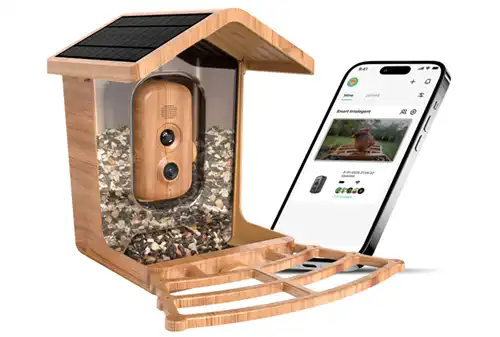
- Birding/garden retail → WiFi + APP gallery as entry-level
4. Compliance Is Not Optional for US/EU Markets
In 2027, compliance isn’t something you “add a label to at the factory.” It’s a market-entry gate. Missing any of the following will get your shipment held at customs, blocked on Amazon, or rejected at distributor QA.
Mandatory Certification Matrix
| Market | Mandatory Certification | Common Pitfall |
|---|---|---|
| United States | FCC Part 15B (EMC) + FCC Part 22/24 (RF) | Completing 15B without RF certification means 4G devices can’t be sold legally |
| European Union | CE (RED Directive + EMC + LVD) | RED cybersecurity amendments effective 2025 require additional assessment for APP-connected products |
| Hazardous substances | RoHS / REACH | California Proposition 65 adds extra disclosure requirements for lead/phthalates |
| Recycling | WEEE (EU) | Registration number must be printed on product packaging |
LTE Band Reference Table (Put This in Your RFQ)
| Region | Required Bands | Notes |
|---|---|---|
| US | B2 / B4 / B12 / B13 / B66 | B12/B13 are critical for rural coverage; missing them = terrible rural signal |
| EU | B1 / B3 / B7 / B8 / B20 | B20 is the primary rural band in Europe |
GDPR and Privacy
If a trail camera is deployed where it may capture people (farm boundaries, job site entrances), EU GDPR applies:
- Privacy notice: Deployment location must display signage indicating “video monitoring in operation”
- Area masking: Configurable privacy mask zones (do not capture/store specific areas)
- Data retention policy: Auto-overwrite/delete schedule must be defined
- Human detection: If person detection is used, legal basis must be established (legitimate interest vs. consent)
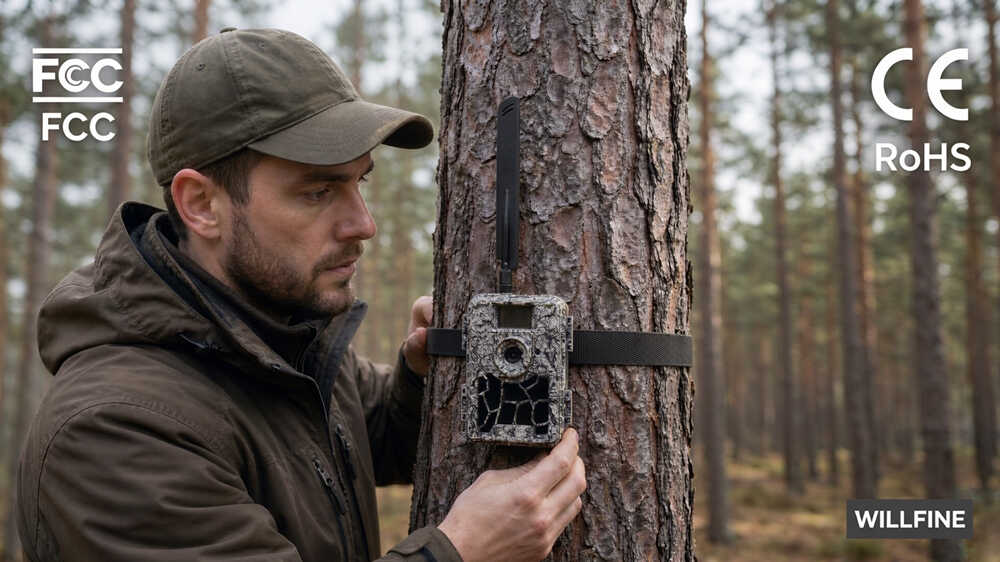
Willfine’s pre-certification platform covers FCC / CE / RoHS / REACH. Certification status for your target market can be confirmed at the RFQ stage, avoiding the “we need to re-test” surprise that kills a Q1 2027 launch.
5. Willfine Supply-Side Facts: Numbers, Not Claims
| Metric | Willfine |
|---|---|
| Quality system | ISO9001 certified |
| First-inspection yield | ≥99.2% |
| Standard lead time | 15–25 days |
| Complex customization lead time | 30–45 days |
| Monthly production capacity | 300,000 units |
| Pre-certification platform | FCC / CE / RoHS / REACH coverage, shortens time-to-market |
What This Means for 2027 Distributors
- ≥99.2% first-inspection yield → DOA rate below 0.8%, no need to reserve large backup inventory
- 15–25 days standard lead time → Short replenishment window during 2027 hunting season; won’t miss peak sales
- 300,000 units/month → Supports annual framework agreements for large accounts; no stockouts from capacity bottlenecks
- Pre-certification → New SKUs don’t need to start certification from zero; 6–8 weeks faster than competitors
6. Distributor Sourcing Checklist
Put every single item below into your RFQ or supplier evaluation sheet. Miss any one of them, and you’ll pay for it within 12 months.
Commercial Terms
| Item | Must Confirm |
|---|---|
| MOQ | Standard vs. customized? Mixed color/config supported? |
| Material lead time | Sensor, 4G module, battery compartment — what are their individual lead times? |
| Firmware ownership | Who owns IP? Can you request an independent branch? |
| APP data ownership | Whose server stores user data? Can it be privately deployed? Can you switch APPs? |
| RMA SLA | What defect rate triggers batch replacement? RMA turnaround days? Who pays shipping? |
| Annual price protection | Price adjustment mechanism during raw material fluctuation? NRE cost-sharing terms? |
Technical Specifications (Review Sections 1–5)
- [ ] PIR zone config + edge animal filtering capability
- [ ] Trigger speed tiers with corresponding power consumption data
- [ ] Connectivity (WiFi / Cellular / SD) with matching band/frequency
- [ ] Compliance certification status vs. target market requirements
- [ ] First-inspection yield and capacity commitment
Ready to Plan Your 2027 Trail Camera Product Line?
cellular trail camera no subscription, FCC compliant wildlife camera, low return rate trail cam supplier — behind these search terms are distributors looking for a reliable supply partner for 2027. They don’t need another spec sheet. They need a procurement framework that protects margin.
Ready to Inquire?
Fill out the inquiry form below with your target market, channel type, and estimated 2027 procurement volume. The Willfine procurement team will respond with a specification framework and TCO analysis tailored to your scenario.
- >>How Researchers Use 4K Trail Cameras — GPS, Timestamps & Low-Disturbance Monitoring | Field Research Selection Guide
- >>4K Cellular Trail Cameras: The Three Costs Buyers Need to Calculate
- >>4K Birding Cameras & Smart Bird Feeders: Why Buyers Should Look Beyond Resolution
- >>4K Trail Camera Engineering Guide: Sensor Selection, False-Trigger Control & Off-Grid Power (Technical Deep-Dive)
- >>4K Trail Cameras for Hunting and Birding: What Professional Buyers Should Care About Beyond “4K”