Cellular Trail Camera Data Cost Calculator: Thumbnail-First Push & On-Demand Pull Guide
September 17, 2026 ︱ By Willfine
1. The SIM Cost Pain Point in Cellular Trail Camera Deployments
When your project scales from a single unit to dozens, hundreds, or even thousands of cellular trail cameras, data costs quickly become an unavoidable portion of operational expenditure (OpEX).
Whether it’s anti-illegal-dumping surveillance, forest fire prevention, farm asset management, or construction site security—every trigger event consumes SIM card data. The traditional model of “uploading full-resolution images or videos on every trigger” creates two direct problems at scale:
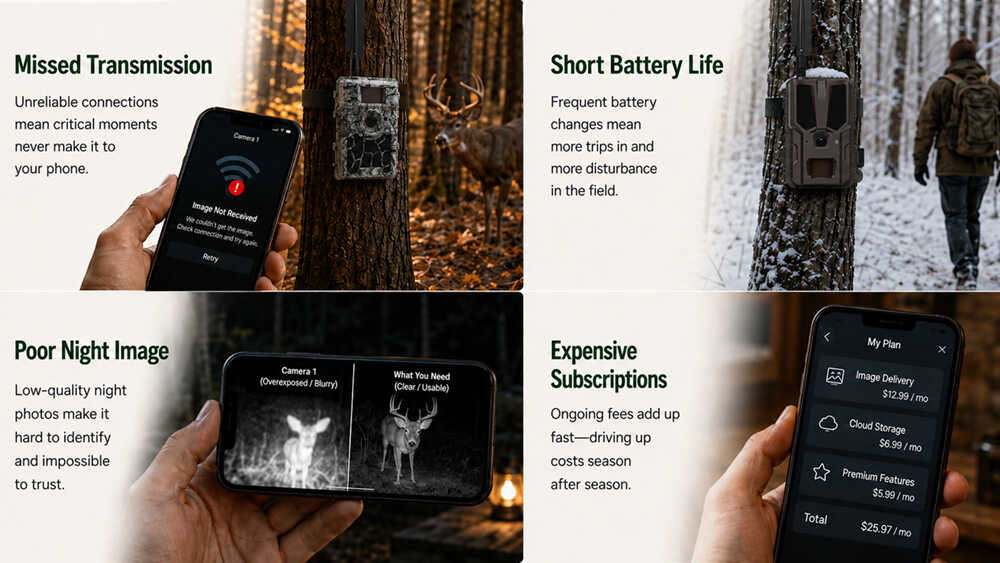
- Unpredictable data bills: Each device triggering dozens of times per day can easily push monthly data consumption into multiple gigabytes, accumulating into massive invoices.
- High ratio of useless data: False triggers from wind, foliage movement, or non-target animals consume bandwidth and storage capacity that could be used for actionable intelligence.
Smart procurement decision-makers no longer ask only “How much does this camera cost?”—they ask: “How can this solution make my monthly data costs predictable and drastically lower?”
2. Core Mechanism: Thumbnail-First + On-Demand Pull
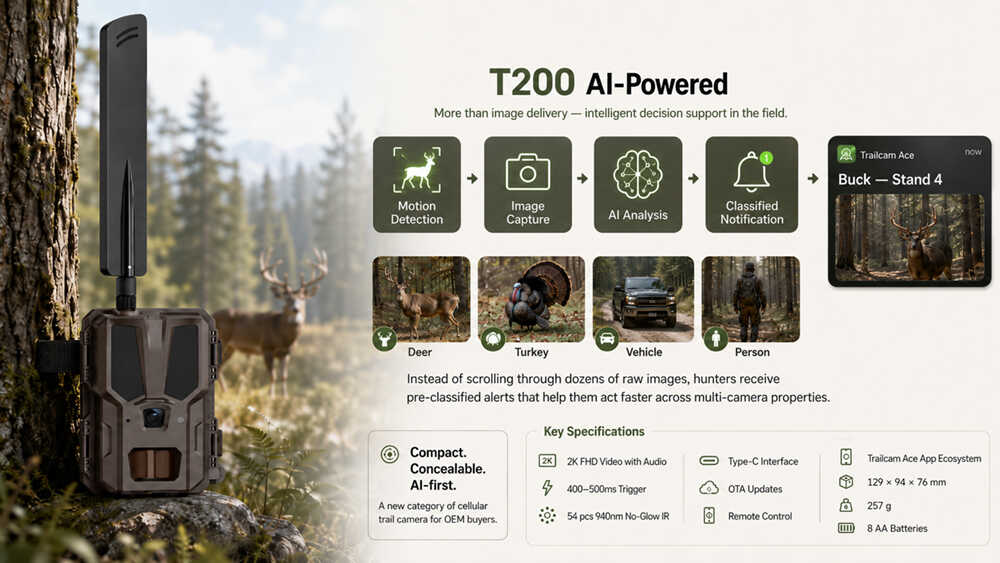
The industry-consensus solution to the above pain points is: Edge AI Filtering → Thumbnail Push → Full-Resolution Image/Video On-Demand Pull.
How It Works
1. Edge AI Filtering (Reducing Invalid Triggers)
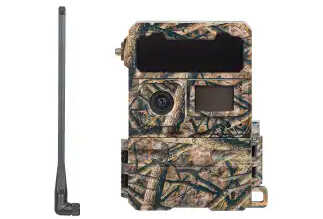
The camera’s built-in intelligent algorithm evaluates whether a trigger event is worth transmitting. Take the Willfine Tank200 as an example: its on-chip AI model intercepts false triggers such as wind gusts and leaf movement at the source, drastically reducing unnecessary uplink traffic. Non-target events are either discarded or stored locally on the SD card, consuming zero cellular data.
2. Thumbnail-First Push (Ultra-Low-Bandwidth Preview)
When a verified valid event is detected (human, target animal, vehicle), the camera immediately uploads a heavily compressed thumbnail—typically just tens of KB—via MQTT or push notification channels. This thumbnail is sufficient for a command center operator or App user to determine whether further investigation is needed.
3. Full-Resolution Image/Video On-Demand Pull (User-Initiated)
After viewing the thumbnail, if the user deems the event important, they click “View HD” or “Download Video.” Only then does the camera establish a data connection to transmit the full 1080p or higher-resolution original image/video. Nothing is pulled unless explicitly requested—shifting data consumption from “passive full push” to “active selective pull.”
Why This Architecture Drastically Optimizes Costs
- Restructured data consumption: The vast majority of triggers only consume the minimal bandwidth of a thumbnail. Only a small fraction of high-value events generate HD data traffic.
- Indirect battery life extension: Reduced data transmission means shorter active time for wireless modules—especially critical for solar-powered or battery-operated devices.
- Reduced cloud storage pressure: Junk images no longer flood the cloud, improving storage efficiency and retrieval speed.
3. Global Regional Deployment Trends & TCO Strategy
Market maturity, compliance requirements, and price sensitivity vary significantly by region—each shaping how “thumbnail-first” strategies should be prioritized. The following represents directional trends for reference (not precise market share data):
| Region | Market Characteristics | TCO Optimization Focus |
|---|---|---|
| North America | High cellular camera penetration; users accustomed to paying for value-added services; competitive market | Emphasize “thumbnail + HD on-demand” for smooth App experience, plus value-add features like GPS anti-theft |
| Europe | Strict data privacy regulations (e.g., GDPR); sensitive to unnecessary data uploads | Highlight the “privacy compliance” advantage of edge AI filtering—irrelevant footage never leaves the device |
| Asia-Pacific | Price-sensitive; project-based demand growing rapidly; extreme focus on low TCO | Solar + low-data mode is the core selling point; SIM costs must be minimized |
| LATAM / MENA | Vast infrastructure gaps; frequent off-grid scenarios; high durability requirements | Non-cellular backup + ultra-low-bandwidth transmission to ensure functionality in weak-network environments |
Key Insight: Regardless of region, procurement decision-makers are shifting from “buying hardware” to “buying ongoing service.” The sustainability of that service depends directly on whether data costs are controllable.
4. Data Cost Estimation Framework (Guided Model)
To help you intuitively understand the budget impact of “thumbnail-first,” we provide the following estimation logic. You can obtain a customized calculation sheet tailored to your project parameters by contacting our team.
Variable Definitions
- Device Count: Total number of cameras deployed
- Daily Trigger Frequency: Average number of trigger events per camera per day (valid + invalid)
- Thumbnail Size: Compressed preview image size (typically 20–100 KB)
- HD Pull Rate: Percentage of events where a user actually clicks to view the full-resolution image/video (typically far below trigger rate)
- Video Pull Rate: Percentage of events where a user requests video playback
Estimation Logic
Monthly Data per Camera ≈
  (Daily Triggers × Thumbnail Size × 30 days)
+ (Daily Triggers × HD Pull Rate × HD Image Size × 30 days)
+ (Daily Triggers × Video Pull Rate × Video Size × 30 days)
+ Heartbeat & Status Packets (fixed small overhead)
Comparative Example (Illustrative, Not a Guarantee)
Assume a medium-frequency scenario: 30 daily triggers per camera, 20% HD pull rate, 5% video pull rate.
- Traditional Mode (full-resolution push on every trigger): Higher data consumption, concentrated cost spikes.
- Thumbnail-First Mode: Significantly lower data consumption, smoother cost structure.
Note: Actual savings vary by environment, trigger quality, and network conditions. We recommend conducting a pilot deployment to obtain precise figures.
5. Willfine In-Action: Tank200 & TA200S Traffic Optimization
Willfine’s two flagship 4G cellular trail cameras have embedded the above logic as their default operating mode:
Willfine Tank200: Edge Filtering + Server-Side 2K Super-Resolution—Making “Data Savings” the Default
The Tank200 doesn’t rely on “pushing large files every time” to guarantee image clarity. Instead, it places intelligence at two strategic points:
- Device Side (Edge): On-chip AI evaluates whether a trigger is worth transmitting. False triggers from wind, foliage, and non-target animals are intercepted locally, reducing uplink data and battery drain at the source. Official data indicates it can cut false alarms by up to ~99%.
- Server Side (Cloud): Standard cellular snapshots are uploaded at minimal cost, then processed through Server-Side 2K AI Super Resolution—enhancing the image to crisp 2K FHD clarity. Only when a project genuinely requires it does the user pull the full 1080p video or original image.
Key specifications: 5MP native CMOS (3072×1728), H.265 High Efficiency Video Coding (HEVC), 54× 940nm No-Glow invisible IR illuminators, multi-band LTE Cat.1 global network coverage, IP66 rating, and up to 6 months off-grid standby. For B2B/B2G customers, its value proposition isn’t “highest pixel count”—it’s:
Delivering adjudicable, clear visuals at minimal uplink cost, while drastically reducing false-alarm maintenance overhead.
This perfectly illustrates why “thumbnail-first + on-demand pull” isn’t a compromise—it’s the more robust TCO strategy for industrial deployments.
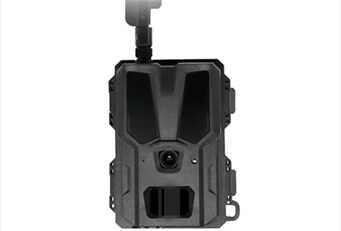
Willfine TA200S: On-Chip Species Recognition + Non-Target Local Storage, Controlling Upload Volume at the Source
The TA200S operates on the principle of “capture abundantly, but only release what matters”:
- Edge-AI Species Recognition: Chip-level models identify specific large-game families (e.g., elk, buck, moose). Non-target events are stored on the SD card only—never uploaded.
- Target-Only Upload: Only when a human or designated animal is recognized does the camera upload a thumbnail and await on-demand pull.
- Codec Optimization: H.265 1080p FHD video further compresses per-file size.
Curious how edge AI and server-side super-resolution work at the architecture level? See the Trail Camera Knowledge Hub.
Summary Comparison
| Dimension | Tank200 | TA200S |
|---|---|---|
| Traffic Optimization Path | Transmit less + enhance clarity in the cloud (2K super-resolution) | Capture more + only release “the right things” from the edge |
| Core AI Capability | On-chip model blocks false alarms (wind/leaves/non-targets) | Species recognition with priority-based transmission tiers |
| Native Image Quality | 5MP + 1080p video + Server-side 2K upscaling | 24MP + H.265 1080p video |
| Ideal Scenarios | Critical infrastructure protection, ecological research, government installations | Large-scale forestry monitoring, anti-fly-tipping, species census |
| Network | Multi-band LTE Cat.1, 100+ countries | 4G LTE Cat.1.bis |
Together, they prove one point: Enterprise-grade cellular trail camera data optimization isn’t an afterthought cost-cutting trick—it’s built into the device architecture.
6. Next Step: Get Your Customized B2B Data Cost Estimation Sheet
The framework in this article is designed to help you build the understanding that “data costs can be controlled.” However, terrain, network environment, and trigger frequency vary drastically from project to project. We cannot provide a one-size-fits-all savings percentage in a public blog post.
If you are planning a project that meets any of the following criteria, we recommend contacting the Willfine B2B team directly:
- Deployment scale of ≥ 50 cellular trail cameras
- Project duration ≥ 12 months
- Requirement for private cloud deployment or API integration
- Strict budget constraints on monthly data costs
Our B2B team will walk you through:
- Data Cost Analysis: Calculating actual data consumption and SIM plan matching for your scenario.
- Integration Strategy: How to connect Willfine cameras to your AWS/Azure or command center.
- Regional Compliance: Key configuration notes for European GDPR and North American carriers.
CONTACT US FOR OEM/ODM CAMERAS
About Willfine
Willfine specializes in 4G/5G cellular trail cameras and remote monitoring solutions, serving global system integrators, B2G project contractors, and enterprise clients. Our solutions are built around “all-in-one service + multi-device sharing + flexible add-on packs”—more adaptable than traditional fixed plans, simpler than modular combinations.
This article is a strategic framework. All data presented is illustrative or trend-based and does not constitute a procurement commitment. For project-specific parameters, please consult the official sales team.
- >>G100 RV Dealership Perimeter Plan | 4G Off-Grid Security Camera for RV Lots
- >>White-Label 4G Off-Grid Cameras vs Consumer RV Cameras for Rental Fleets
- >>How to Choose a Trail Camera Lens? Focal Length, FOV & Real-World Scenarios Explained
- >>Buyer's Factory Audit Manual: How to Audit a Chinese Trail Camera OEM/ODM Factory
- >>SPYPOINT / Moultrie / Bushnell / Browning vs. Willfine: Trail Camera Architecture Teardown for OEM Buyers