B2G Trail Camera Guide: 940nm No-Glow, Vandal-Proof & Cold-Weather SOP
September 18, 2026 ︱ By Willfine
Preface: From a Device Catalog to an Engineering Deliverable
This guide is intended for B2G and B2B deployment decision-makers: municipal enforcement departments, parks and wildlife agencies, forestry and water-resource authorities, research institutions, and the system integrators that serve them.
A trail camera is a mass-market consumer product. A municipal enforcement system is an engineering deliverable. The gap between the two is not a price difference—it is a difference in deliverables. A consumer buyer receives a box; an enforcement buyer receives a defensible outcome.
This guide is built around three premises:
- A project succeeds or fails at the deployment layer, not the procurement layer. No specification can compensate for a wrong-facing lens, an under-dimensioned battery bank, or a device whose recorded footage cannot survive a chain-of-custody challenge.
- Stealth, ruggedness, and evidence integrity are not features; they are the project’s acceptance criteria. If an anti-dumping camera glows visible red at night, it has already lost the case. If footage lacks an unbroken timestamp, it may be inadmissible. These are not marketing claims—they are the conditions under which the project exists.
- The value of a vendor lies in handling uncertainty. Spec sheets describe ideal conditions. Engineering guides describe what to do when conditions are not ideal.
The Willfine product family is positioned as the baseline for this guide: 4G cellular connectivity, 940nm no-glow infrared, solar autonomy, and edge AI analytics. The deployment logic, however, is vendor-neutral. Where Willfine’s lineup provides a specific configuration, that is stated directly. Where a project requires capabilities outside the current lineup, that limitation is stated directly as well.
Scope and qualification: The environmental thresholds, battery performance figures, and compliance pathways in this guide are engineering reference values. They must be read against two constraints:
- They describe baseline configurations. Enclosure material, cell chemistry, heater power draw, mounting method, and target market all change the outcome.
- They are separate from the unit-level certifications shipped with each order. Certification status is model- and region-specific and is documented in Section 9.1.
Parameters affecting bid compliance—infrared wavelength, trigger interval, ingress rating, operating temperature, and certification—must be confirmed against the official comparison tool or the specification sheet issued for the specific model and configuration. The same model sold in different target markets may use different wireless modules and carry different certification identifiers.
1. What Counts as a B2G Scenario—and Why the Requirements Diverge
B2G projects do not share a single technical requirement. They share a procurement structure: the buyer is an institution, the decision is documented, and the outcome is audited. Within that structure, three scenario families recur, and their priorities are materially different.
1.1 Illegal Dumping and Theft Prevention
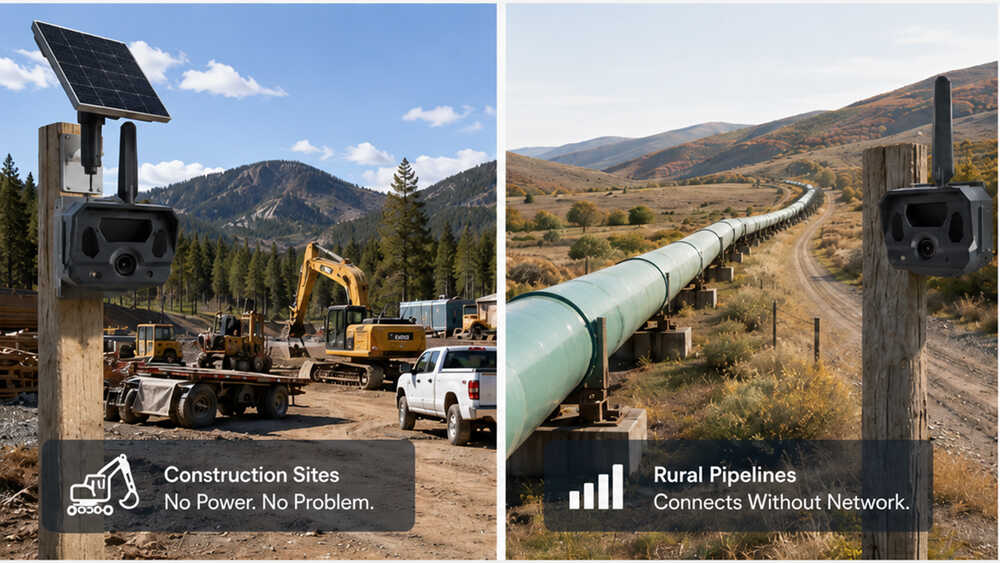
The typical site is a remote transfer station, a green belt, a construction-site perimeter, or an unmanaged roadside stretch. The technical requirement is continuous coverage of a defined zone, not random event capture.
| Requirement | Engineering Implication |
|---|---|
| Continuous coverage | Scheduled or buffered 24/7 recording; event-only capture will miss the act |
| Identification of person and vehicle | Resolution sufficient for plate or facial comparison; stable daytime color |
| Night operation without detection | 940nm no-glow illumination; no visible LED emission |
| Deterrence | Two-way audio or a visible, legal warning sign |
| Vandalism resistance | IK-rated enclosure; tamper-alert on dismount |
| Prosecution-grade footage | Unbroken timestamp; secure storage; documented access |
The Willfine G100 + T200 combination has been deployed for 24/7 monitoring of waste disposal sites, achieving 92% accuracy in violation detection and reducing illegal dumping rates by 80%. This is a reference result for the configuration, not a guaranteed project outcome.
1.2 Forestry, Fisheries, and Wildlife Infringement
The site is distributed across kilometers of forest road, river, or coastline. The technical requirement is low false positives at scale.
Wind, shadow, rain, snow, and insects produce false triggers that consume storage and bury real events in review queues. The response is edge-side classification rather than indiscriminate capture: classify person, vehicle, and animal at the device, transmit only the relevant event, and retain the full record locally for audit.
For research applications, the requirement tightens further. The T5.8-CS+ with custom AI models identified three invasive rodent species with 97% monitoring accuracy in a documented field deployment. A custom model is a separate workstream from hardware supply and must be scoped and budgeted independently.
1.3 Water Level, Climate, and Habitat Long-Term Monitoring
This scenario is not security at all. It requires time-series continuity: the same frame, the same angle, the same interval, for months.
A 50-node water-level monitoring network has been deployed to transmit real-time level data, provide 72-hour flood-risk early warnings, and prevent economic losses exceeding USD 10 million. The engineering lessons from that deployment are portable:
- One failed node degrades the entire forecast model. Redundancy and remote health reporting are not optional.
- Power and connectivity must persist through the season with no site visit.
- Data must remain comparable across the full deployment period. Firmware changes mid-project require a versioning decision.
1.4 Extreme Cold Is Not a Fifth Scenario—It Is a Cross-Cutting Constraint
Cold does not replace any of the above requirements. It makes every one of them harder to meet. A no-glow LED operates at lower photon efficiency at low temperature. A battery that delivers rated capacity at 25°C may deliver a fraction of it at -30°C. A sealed enclosure that survives summer heat may ice over and fail a tamper check.
Cold-weather deployment is therefore treated in this guide as an environmental layer applied on top of the scenario, addressed in Section 5.
2. 940nm No-Glow: What It Actually Buys, and What It Costs
No-glow is the single most consequential choice in a covert deployment. It is also the choice most often described in marketing language rather than engineering terms.
2.1 The Wavelength Decision
Infrared illumination is invisible to the human eye only above approximately 830nm. Two bands are in common use:
- 850nm: Higher photon efficiency, longer effective range, but produces a faint visible red glow at the emitter. Detectable at close range, especially by a person who knows where to look.
- 940nm: Effectively no visible glow. The cost is lower photon efficiency—sensitivity falls to roughly 50–60% of the 850nm figure at the sensor, and usable range contracts by an estimated 30–50% for the same LED power.
| Dimension | 850nm IR | 940nm No-Glow |
|---|---|---|
| Visible glow | Faint red, detectable | None |
| Relative sensitivity | 100% (baseline) | 50–60% |
| Effective range | Longer | 30–50% shorter for equivalent LED power |
| Cost position | Standard | System cost typically 40–80% higher |
| Proper use | Perimeter lighting, general monitoring | Covert enforcement, research, anti-theft |
| Wrong choice | Covert anti-dumping, research | Open perimeter where range matters more than stealth |
2.2 The Counter-Intuitive Point
For an anti-dumping camera, the correct choice is 940nm, even though it reduces range and raises cost. A camera that glows red at night has failed its primary requirement before it has recorded a single frame: the subject will avoid the glow, or the glow itself becomes the evidence that the installation was detectable.
2.3 What 940nm Does Not Solve
No-glow addresses only the infrared emitter. It does not address:
- The visible outline of the enclosure against foliage
- Audible clicks from the shutter or relay
- Cellular radio emission, which can be detected
- Physical discovery during routine site activity
For high-value covert applications, enclosure camouflage and mounting discretion remain separate design tasks.
2.4 Model Configuration
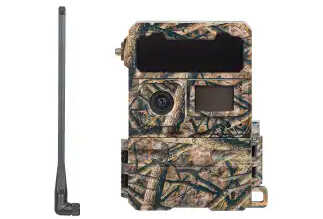
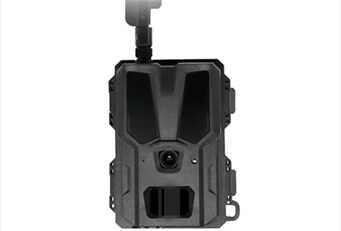
The Willfine trail camera lineup carries 940nm no-glow across multiple models, with variations in LED count and 4G category:
| Model | 4G Category | Infrared | Ingress | AI | Operating Temperature |
|---|---|---|---|---|---|
| T200 | Cat.1 | 54×940nm | IP66 | Person / vehicle / animal classification | -20~55°C |
| T4.0-CG | Cat.1 | — | IP66 | — | — |
| T4.0-T-CS | Cat.1 | — | IP66 | — | -20~55°C |
| 5.8T-CG | Cat.1 bis | 60×940nm | IP66 | — | — |
| T5.8-CS | Cat.4 | 940nm | IP66 | — | -20~55°C |
| 4.0P-CS | Cat.4 | 59×no-glow | IP66 | — | — |
Model availability, exact configuration, and regional variants must be confirmed against the official comparison tool before specification. The operating temperature figures above describe baseline configurations and are not certification temperature ratings.
3. Vandal-Proof: What the Rating Means, and What It Does Not
Vandal-proof is a term applied to products at very different levels of actual resistance. A procurement document should specify the test, not the adjective.
3.1 IK Rating as a Measurable Standard
The IK scale measures resistance to mechanical impact, expressed in joules. It is defined in IEC 62262 (which replaced EN 50102 and BS EN 62262:2002).
| IK Code | Impact Energy | Equivalent |
|---|---|---|
| IK06 | 1 J | 0.5 kg mass from 20 cm |
| IK07 | 2 J | 0.5 kg mass from 40 cm |
| IK08 | 5 J | 1.7 kg mass from 29.5 cm |
| IK09 | 10 J | 5 kg mass from 20 cm |
| IK10 | 20 J | 5 kg mass from 40 cm |
IK10 is the upper limit of the standard scale. It is a meaningful specification for an enclosure exposed to public access. It is not, however, a guarantee against deliberate destruction with tools.
3.2 What Determines the Actual Rating
An IK rating applies to a fully assembled enclosure tested as installed. A loose internal component can fail while the shell passes. For an anti-dumping site, the housing is only one layer:
- Mounting: Tamper-rated screws; concealed or elevated fixings; anti-rotation brackets.
- Cable path: Entry points are common failure locations and must be sealed and strain-relieved.
- Visibility: A camera discovered is a camera disabled. Concealment is a security function.
- Detection of interference: A dismount, obstruction, or lens-cover event should generate an alert.
3.3 The Credibility Barrier
Any public claim of vandal resistance should be supported by a test report from a qualified laboratory. A procurement specification should name the standard, the test house, and the report reference. A self-description without these elements will not survive a technical bid review.
3.4 Matching Resistance to Threat Level
| Threat Level | Expected Action | Suitable Enclosure Approach |
|---|---|---|
| Low | Accidental contact, casual interference | Standard rugged housing, IP66, tamper screws |
| Medium | Deliberate kicking, thrown objects, tool-assisted | IK08–IK10 rated shell, concealed mounting, elevated bracket |
| High | Sustained attack, known location, repeated targeting | Reinforced enclosures, secondary covert unit, monitored alarm |
The third row is the important one. At high threat levels, a visible camera is a target regardless of rating. The correct design is layered: a visible deterrent unit and a concealed evidentiary unit, each triggering the other.
4. Batteries and Power: The Part That Fails First
Power is the dominant cause of unattended-system failure in cold environments. It also has the largest performance spread between specification and field result.
4.1 Cell Chemistry and the Temperature Curve
The usable capacity of a lithium cell falls as temperature falls, and the rate of fall is chemistry-dependent.
| Chemistry | Composition | Typical -40°C Usable Capacity | Cold-Weather Position |
|---|---|---|---|
| LiFePO4 (LFP) | Lithium iron phosphate | 40–50% of rated | Stable chemistry; reduced capacity |
| NMC (NCM) | Nickel manganese cobalt | 50–70% of rated | Moderate cold tolerance |
| LCO | Lithium cobalt oxide | 11.7% of rated (measured) | Unsuitable for cold deployment |
The inference from these figures is direct: a camera specified for -40°C operation requires either low-temperature-rated cells or an active heating solution. A standard LCO pack will not meet the requirement.
These values are representative engineering data, not product-specific guarantees. A bid should be supported by the low-temperature discharge curve from the cell manufacturer or a third-party test report for the actual pack used.
4.2 Cold Starting: The Hidden Failure Mode
A battery may retain capacity and still fail to start the device. Below a cell-specific threshold, voltage collapses under load. Three responses are used:
- Heated battery compartment: A resistive element brings the pack above its discharge threshold before the main system draws current. Power budget must include heater duty cycle.
- Pulse preheating: Short current pulses warm the cells resistively. Lower average power than continuous heating, but adds startup latency.
- Supercapacitor buffer: Supplies the surge current for the startup transient, bridging the interval until the cells recover.
The choice depends on the duty cycle. A device that starts once per season can afford a long preheat. A device that must cold-start repeatedly cannot.
4.3 Solar Sizing in Low-Irradiance Regions
Solar autonomy is a function of irradiance, tilt, and snow, not panel wattage alone.
- Tilt angle: A working rule is local latitude plus 15°, adjusted for seasonal snow shedding and the target season.
- Low-sunlight configuration: Dual-power models with an external battery box are recommended, extending autonomy to 18+ months.
- Panel specification must state test conditions. A wattage without an irradiance basis is not usable for sizing.
4.4 Trigger Speed as a System Parameter
For evidence capture, trigger speed determines whether the recorded frame shows the act or only its aftermath.
| Performance Band | Trigger Interval | Suitable Application |
|---|---|---|
| 0.2–0.4s | Flagship trail camera specification | Behavioral capture, research, fast-moving subjects |
| ~1.0s | Entry-level specification | Stationary surveillance, time-lapse, low-traffic sites |
For enforcement use, the working rule is 0.2–0.4s. A camera that takes a full second to trigger will record a vehicle rear panel, not a face or a plate.
5. The Cold-Weather Deployment SOP
This section is the operational core of the guide. It assumes the scenario requirements from Section 1 have already been defined.
5.1 Step 1 — Site Survey
Record, per planned node:
- Latitude, aspect, and seasonal shading
- Lowest expected ambient temperature, with source
- Days-of-autonomy target
- Cellular signal strength by carrier, measured on-site
- Access constraints and visit frequency
- Threat level (Section 3.4)
- Whether 24/7 recording or event capture is required
A site survey without a signal measurement is not a survey. Coverage maps do not resolve terrain, foliage, or seasonal canopy changes.
5.2 Step 2 — Configuration Selection
Work through the decision tree in order:
Power first. Establish the temperature class, then the autonomy target, then the panel-and-battery combination. This is the sequence in which failures occur: a wrong power decision invalidates every other choice.
Detection second. Select 850nm or 940nm based on the stealth requirement. For any enforcement or research use, this is settled: 940nm.
Enclosure third. Match the IK rating and mounting method to the threat level.
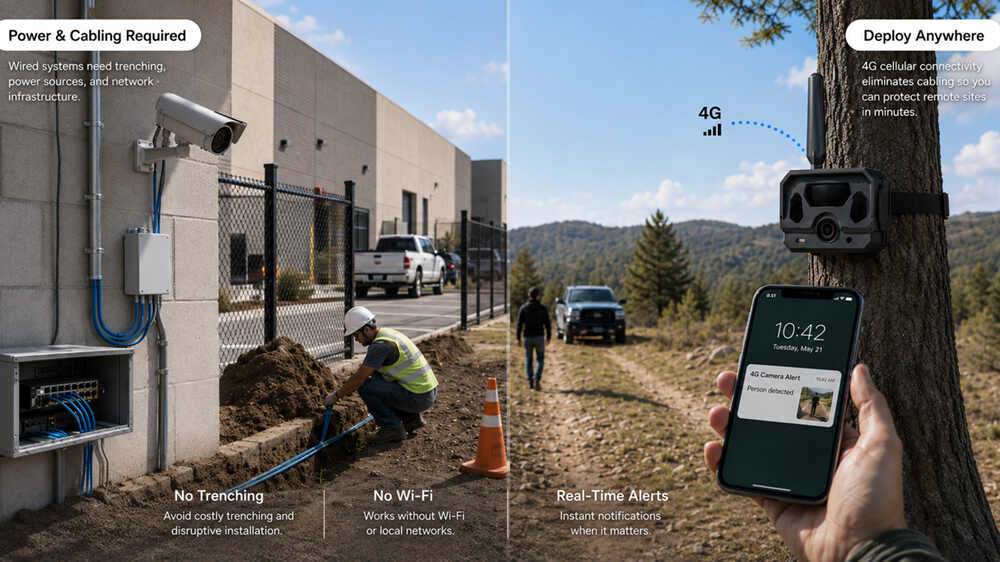
Connectivity last. 4G category and carrier are determined by the data volume produced by the choices above, not by a separate preference. A 24/7 video configuration produces a different data requirement from event-only stills.
5.3 Step 3 — Installation
- Face the unit away from direct thermal sources and prevailing wind-driven snow.
- Use UV-stable, stainless or corrosion-rated fixings appropriate to the substrate.
- Seal every cable entry. Verify the seal after the first freeze-thaw cycle.
- Install a reference object of known dimension and reflectance in the frame for scale and exposure calibration.
- Record the GPS coordinate, serial number, installation date, and officer or technician responsible.
5.4 Step 4 — Cold-Start Verification
This step is the difference between a tested system and an assumed one.
Before commissioning, place the unit at the expected low temperature and execute a controlled cold-start test. Verify:
- Successful boot from cold soak
- LTE registration and first transmission
- Recording initiation
- Battery voltage under load
- Heater duty cycle, where applicable
A system that has not passed a cold-start test has not been deployed. It has been installed.
5.5 Step 5 — Maintenance and Inspection
| Interval | Check |
|---|---|
| Each site visit | Lens cleanliness, enclosure seal, bracket torque, antenna condition |
| Monthly (remote) | Battery state, signal quality, storage remaining, alert count |
| Seasonally | Panel output under comparable irradiance; cable entry reseal |
| Pre-winter | Cold-start test record; heater function; battery replacement schedule |
5.6 Step 6 — The Fault Tree
| Symptom | Likely Cause | Action |
|---|---|---|
| Unit offline after cold front | Battery voltage collapse | Verify cell temperature and voltage under load; test cold start |
| Short recording duration | Excessive false triggers | Tune PIR sensitivity and detection zone; review classification settings |
| Snow accumulation on lens | Mounting angle or panel tilt | Adjust tilt and clear line of sight |
| Night footage washed out | IR reflection from nearby surface | Relocate to increase standoff; shield reflector |
| Missed events | Trigger interval too long | Reconfigure to 0.2–0.4s band |
| Footage timestamp inconsistent | NTP sync failure | Check connectivity and time-source configuration |
5.7 Step 7 — Acceptance
Acceptance is not power-on. It is documented evidence that the system meets each requirement under the conditions stated in the specification. Retain the survey record, the configuration decision, the cold-start test result, and the commissioning report as a set.
6. Chain of Custody: When Footage Becomes Evidence
A covert camera project that cannot demonstrate an unbroken chain of custody has not produced evidence. It has produced video.
6.1 The Three Locks
Lock 1 — Timestamp integrity. Every frame carries a timestamp. The device synchronizes to an authoritative time source (NTP or equivalent) on a defined schedule. The time zone is recorded. Any manual adjustment is logged with operator identity and reason.
Lock 2 — File integrity. Files are protected against overwrite except under a defined and logged retention policy. Any transfer is checksummed or hash-verified. The hash, the transfer time, and the recipient are recorded.
Lock 3 — Access control. User access is role-based. The audit log records login, export, deletion, and configuration change. The log itself must be protected from deletion by ordinary users.
6.2 What Must Be Retained
At minimum, an evidentiary system should retain:
- Original files, unaltered
- Timestamp source and synchronization record
- Device serial number and configuration at time of capture
- Installation record and location
- Access log covering the full retention period
- Export log for every file leaving the system
6.3 What This Guide Cannot Determine
Retention period, lawful deployment basis, signage requirements, and admissibility standards are jurisdiction-specific. They vary by country and, in federal systems, by state or province. This guide does not establish legal compliance for any jurisdiction. That determination must be made by the procuring authority’s legal counsel or compliance officer.
6.4 Storage and Transmission Model
Willfine offers three storage and transmission models. The FTP/SMTP version is available at the same price as the standard version, with no premium markup. This matters for evidentiary use: automated transfer to a controlled destination reduces the reliance on device-local storage and produces a transfer record.
6.5 Cloud and App Customization
The platform supports Camera Customization, Cloud System customization, and App customization. For fleet deployments of 50 units or more, a PC-based backend dashboard is available with multi-user permission control. This is the structure through which chain-of-custody controls are most readily implemented.
7. The Bid Specification Cross-Reference
This table is designed to be copied into a technical bid. Mark the compliance status directly in the left column.
| # | Requirement | Confirmation Method |
|---|---|---|
| 1 | Infrared illumination: 940nm no-glow, with no visible emission in the 850nm band | Model specification and test report |
| 2 | Trigger speed: 0.2–0.4s band for enforcement applications | Product comparison tool and test report |
| 3 | Resolution: 4K UHD for identification-grade capture | Model specification |
| 4 | Ingress protection: IP66 or higher, with test basis stated | Certification documentation |
| 5 | Vandal resistance: stated IK rating with test house and report | IEC 62262 test report |
| 6 | Low-temperature operation: stated temperature class with discharge curve | Manufacturer curve or third-party report |
| 7 | Battery autonomy: days-of-autonomy figure under stated irradiance | Configuration calculation and field test |
| 8 | Solar specification: panel rating with test conditions | Product datasheet |
| 9 | Cellular: 4G category and supported bands for target market | Regional version specification |
| 10 | Edge AI classification: person / vehicle / animal, with accuracy basis | Model documentation and validation record |
| 11 | Certifications: CE, FCC, and model-specific compliance documentation | Shipped with order; local compliance support available |
| 12 | Timestamp integrity and access logging | Platform specification and demonstration |
| 13 | Off-grid power autonomy | Configuration selection and sizing calculation |
| 14 | Custom model and SDK availability | Customization tier and scope agreement |
On parameters 1, 2, 4, and 7: model-to-model variation exists. Confirm against the official comparison tool for the exact model and configuration, or request the specification sheet from the sales team before bid submission.
8. Compliance and Certification
This section distinguishes between compliance claims that apply across the lineup and those that attach to a specific model and market.
8.1 Across-the-Lineup Compliance
The following are stated across the Willfine trail camera range:
- IP66 ingress protection
- CE self-declaration
- RoHS compliance
- Operating temperature: -20°C to 55°C (baseline configurations)
- H.265 encoding
8.2 Model- and Region-Specific Compliance
The following are configuration-dependent and must be confirmed per order:
| Item | Notes |
|---|---|
| FCC and CE certification | Applies to wireless models; tied to model and wireless module |
| 4G frequency band | Region-specific; the correct hardware version must be selected |
| GPS | Configuration-dependent |
| Solar panel specification | Must state test conditions |
| Cloud and OTA protocol | Subject to platform and customization agreement |
Certification documents are shipped with each bulk order. Support for local compliance testing in the target market is available. OEM partners receive priority support for new certifications.
8.3 On Certificate Identifiers
This guide does not publish certificate numbers. Certification identifiers are issued against a specific model, configuration, and market. A number published without that context is not a verifiable claim.
For bid submission, request the Declaration of Conformity and test reports for the exact model and configuration from the sales team. Each wireless variant may carry a different FCC ID. This must be reconciled before the bid document is finalized.
8.4 Regional Wireless Versions
Willfine provides region-specific versions to ensure compatibility with local carriers. State the target country and preferred carrier; the correct hardware version will be recommended, together with a pre-shipment network test report.
Canada and Australia require separate consideration: IC certification (Canada) and RCM compliance (Australia) are distinct from FCC and CE. If the project covers these markets, name them explicitly in the specification so the compliance pathway can be confirmed.
8.5 OEM and Customization
Four tiers of OEM and ODM service are offered. MOQ and pricing vary by customization tier, and some modifications incur engineering fees. Full customization details are disclosed under NDA after initial consultation.
The published MOQ is 500 PCS, but this is flexible and depends on the customization tier selected. Final quantity and pricing are assessed against current production capacity, component availability, and the specific configuration.
8.6 Response Commitment
The team commits to a response within one business hour. For MOQ and pricing tailored to a customization requirement, the business license or brand registration should be available.
8.7 On Published Performance Data
Performance data is verified through controlled laboratory tests and field trials. A full test report is available on request for bulk buyers.
9. How to Use This Guide
9.1 For the Technical Reviewer
Read Sections 2, 3, and 4 first. These define the three acceptance criteria that cannot be negotiated: stealth, ruggedness, and power. If the project cannot meet any one of them, no configuration work will recover it.
9.2 For the Installer
Follow the seven-step SOP in Section 5. Do not skip Step 4. Cold-start verification is the lowest-cost step in the entire deployment and the one most often omitted.
9.3 For the Procurement Officer
Use the bid cross-reference table in Section 7. The most common bid failure is a requirement stated without a confirmation method. Every line in the table carries one.
9.4 For the Sales Engineer
Treat this guide as a shared technical vocabulary, not a quotation. Quantities, unit pricing, engineering fees, and delivery terms are determined through the sales channel. The customization tier and the target market together determine what can be delivered.
9.5 On the Source of the Figures in This Guide
The numerical values in this guide—temperature thresholds, capacity retention, IK energy levels, solar autonomy, and performance specifications—are engineering reference values drawn from controlled laboratory testing, field trials, and published technical sources. They describe baseline configurations and are intended to support specification and deployment decisions.
They are not substitutes for the certification documentation shipped with an order, nor for a model-specific test report. Before bid submission, confirm the parameters that affect compliance against the official product comparison tool or the specification sheet for the exact model and configuration.
Appendix A: Model Configuration Reference
| Model | 4G Category | Infrared | Ingress | AI | Operating Temperature |
|---|---|---|---|---|---|
| T200 | Cat.1 | 54×940nm | IP66 | Person / vehicle / animal classification | -20~55°C |
| T4.0-CG | Cat.1 | — | IP66 | — | — |
| T4.0-T-CS | Cat.1 | — | IP66 | — | -20~55°C |
| 5.8T-CG | Cat.1 bis | 60×940nm | IP66 | — | — |
| T5.8-CS | Cat.4 | 940nm | IP66 | — | — |
| 4.0P-CS | Cat.4 | 59×no-glow | IP66 | — | — |
This table is a configuration reference. It does not constitute a complete specification. Confirm against the official comparison tool:
Compare Trail Cameras & Bird Watching Cameras | Side-by-Side
Compare Trail Cameras & Bird Watching Cameras | Side-by-Side
Appendix B: Scenario-to-Model Selection
| Scenario | Primary Configuration | Basis |
|---|---|---|
| Illegal dumping | G100 + T200 combination | Field deployment: 92% violation detection, 80% reduction in illegal dumping |
| Remote forest and deep-cover security | 5.8T-CG | 60×940nm, Cat.1 bis, IP66 |
| Ecological research with custom classification | T5.8-CS+ custom AI model | Field deployment: 3 invasive rodent species identified, 97% accuracy |
| Water-level and environmental monitoring | 4G networked nodes | 50-node reference deployment, 72-hour flood warning |
| High-value covert monitoring | 940nm no-glow configuration | No visible emission; secondary concealed unit recommended |
Willfine designs and manufactures 4G cellular trail cameras for off-grid deployment. The product family supports 4K UHD, 0.2–0.4s trigger speed, 940nm no-glow night vision, solar-ready autonomy, edge AI analytics, and OEM/ODM customization. This guide describes deployment engineering. It does not constitute legal, regulatory, or certification advice for any jurisdiction.
This guide is published by Willfine. It is intended as deployment engineering reference and does not constitute legal, regulatory, or certification advice for any jurisdiction.
CONTACT US FOR OEM/ODM CAMERAS
Product specifications, certifications, MOQ, and pricing are confirmed through the official channels below:
- >>G100 RV Dealership Perimeter Plan | 4G Off-Grid Security Camera for RV Lots
- >>White-Label 4G Off-Grid Cameras vs Consumer RV Cameras for Rental Fleets
- >>How to Choose a Trail Camera Lens? Focal Length, FOV & Real-World Scenarios Explained
- >>Buyer's Factory Audit Manual: How to Audit a Chinese Trail Camera OEM/ODM Factory
- >>SPYPOINT / Moultrie / Bushnell / Browning vs. Willfine: Trail Camera Architecture Teardown for OEM Buyers