4K Trail Cameras for Hunting and Birding: What Professional Buyers Should Care About Beyond “4K”
November 3, 2026 ︱ By Willfine
4K Trail Cameras for Hunting and Birding: What Professional Buyers Should Care About Beyond “4K”
Over the past two years, searches for “4K trail camera” have continued to rise across North America and Europe. Whether it’s ranch owners in the U.S., birding brands in Europe, or wildlife research institutions, one question keeps coming up: can we go 4K?
As a trail camera and birding camera manufacturer with over 20 years of ODM/OEM experience, our answer is straightforward:
4K is a trend, but not every project should rush into it. A professional buyer should evaluate the use case first, then decide on resolution.
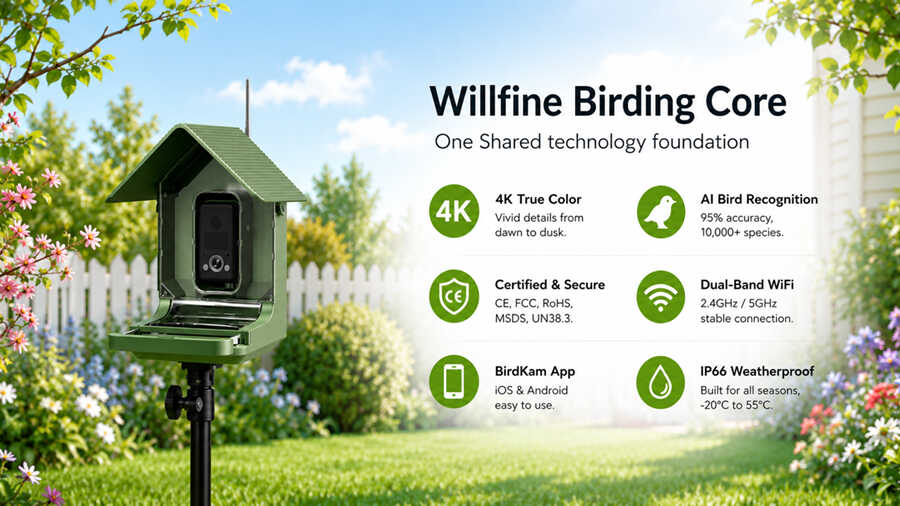
This article explains the real value of 4K in field monitoring, its hidden costs, and how to specify it correctly from a manufacturer’s engineering perspective.
1. The Real Value of 4K: From “Seeing” to “Analyzing”
In wildlife observation, 4K resolution serves very specific purposes:
- In birding scenarios, it helps distinguish feather textures, iris color, and beak shape.
- In research projects, it supports individual identification, behavioral analysis, and long-term data archiving.
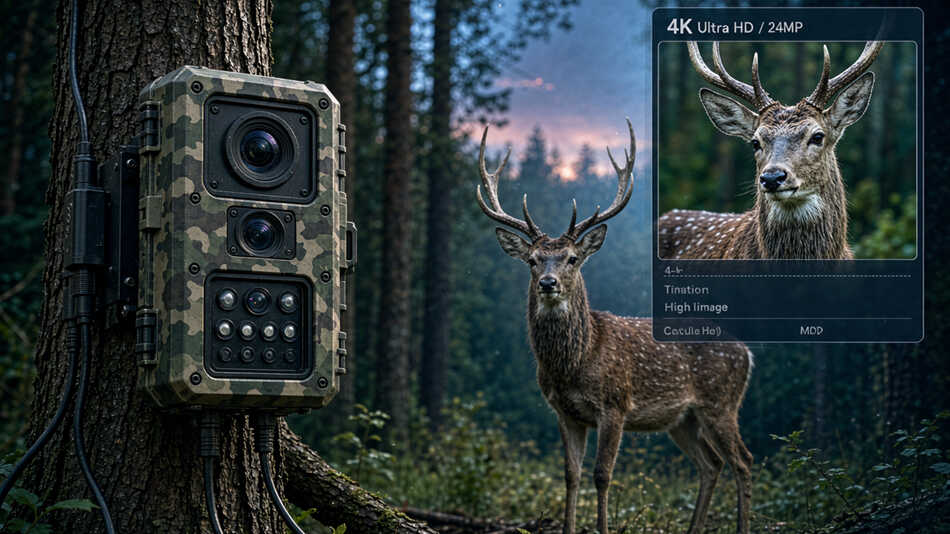
- In premium hunting management, it allows buyers to examine antler structure, coat patterns, and body size more clearly.
In these cases, 4K is not just “a little sharper.” It turns casual footage into actionable visual data.
The problem is that many factories simply pair generic modules with interpolated pixels. Small CMOS sensors forced into high resolution may look good in daylight but produce heavy noise at dawn, dusk, and night. For field users, that kind of 4K is little more than a marketing claim.
2. Five Real Pain Points Buyers Face with 4K
File Size: Storage and Data Costs Break First
A 4K video file can be four to five times larger than 1080p. Without edge filtering or smart transmission logic, the result is predictable:
- SD cards fill up within weeks.
- Cellular data bills double or triple.
- Users receive hours of useless 4K clips triggered by wind and shadows.
Willfine’s approach: 4K is not treated as continuous recording. Instead, we use event-triggered capture, key-frame extraction, and edge AI pre-screening. High-value images are transmitted only when a target animal is detected, keeping cloud storage and data costs under control.
Nighttime 4K Can Actually Look Worse
Small sensors with high pixel counts reduce the light-gathering area of each pixel. At dawn, dusk, or on moonless nights, noise levels can become worse than those of a well-tuned 2K camera.
Willfine’s approach: We customize larger sensors—such as 1/1.8-inch or 1/2-inch formats—paired with 940nm no-glow infrared arrays and AI noise-reduction ISP tuning. When needed, we apply a dual-mode strategy: true-color by day and clear monochrome at night. The goal is usable detail, not just a 4K label.
False Triggers Waste Everything at 4K
Traditional PIR sensors often fire on moving branches, insects, or shifting light. At 4K resolution, every false trigger becomes more expensive in terms of battery, storage, and bandwidth.
Willfine’s approach: We run Edge AI directly on the camera chip, enabling software-defined masking zones and species recognition. Squirrels, swaying leaves, and shadows are filtered out, while deer, bears, humans, and target bird species are captured. In real deployments, invalid triggers can be reduced by 70% to 90%.
Battery Life Collapses Without System-Level Optimization
Field deployments often make monthly battery changes impractical. 4K encoding combined with continuous transmission can cut a camera’s field life from months to weeks.
Willfine’s approach: We design around low-power SoC platforms such as Novatek and Anyka, deep-sleep power gating, and solar-assisted architectures. 4K is enabled for scheduled clips or high-value events rather than constant streaming, preserving overall battery life. Enterprise projects can run continuously for up to 180 days.
Buyers Need More Than Hardware: Branding, Cloud, and Compliance
European and North American brands increasingly care about:
- Whether the mobile app carries their own brand identity.
- Where user data is stored and whether private cloud deployment is supported.
- Whether the product meets FCC, CE-RED, RoHS, and other regional requirements.
- Whether regional firmware and data plans can be separated.
Willfine’s approach: We provide white-label iOS and Android apps, private cloud deployment on AWS or Oracle, strict NDA protection, FCC/CE certification support, and complete API documentation. 4K becomes one layer of a fully branded solution rather than a standalone spec.
3. How to Choose Resolution by Scenario
| Scenario | Primary Need | Recommended Configuration |
|---|---|---|
| Premium birding and eco-recording | Feather detail, color accuracy | Start with 2.7K; customize 4K with anti-fog lens coating |
| Wildlife research | Individual ID, low disturbance, long-term deployment | 4K event capture + GPS watermark + edge tagging |
| Hunting and scouting | Fast assessment, battery life, long-range performance | 1080p or 2K as standard; optional 4K playback clips |
| Ranch and perimeter security | Human/vehicle classification, data efficiency | 1080p + AI filtering + solar 4G |
| Brand premium line | Differentiation and higher margins | 4K high-end version + Dr. Bird AI + white-label cloud |
The conclusion is clear: hunting scenarios prioritize speed and reliability, while birding and research scenarios demand detail and fidelity. 4K is not a one-size-fits-all answer, but a configurable module defined by use case.
4. Willfine’s 4K Customization Logic: Specifications First, System Always
Our standard platforms focus on proven 1080p and 2K performance, optimized for stability, low power consumption, and mass production. 4K is delivered through a deep ODM customization process. A typical project follows this path:
- Scenario definition — research, birding, hunting, or security.
- Sensor and lens selection — prioritizing per-pixel light intake, dynamic range, and distortion control rather than pixel count alone.
- Edge AI tuning — target filtering, species models, and false-trigger zone masking.
- Firmware and transmission strategy — event triggers, super-resolution reconstruction, and low-bitrate transmission.
- App, cloud, and compliance — white-label apps, private cloud, FCC/CE certification, and NDA protection.
- Sampling to mass production — functional samples in 7–10 days, pilot verification, and monthly capacity of 300,000 units.
For brand owners, the deliverable is not just “a 4K camera,” but a complete observation system that justifies a premium position in the market.
5. Six Questions Buyers Should Answer Before Requesting 4K
Before asking a factory for “a 4K trail camera,” procurement teams should align internally on these questions:
- Do you need continuous 4K recording, or event-based 4K capture?
- Will the cameras operate in daylight forests, dark night environments, or high-altitude uninhabited areas?
- Is solar power available for battery support?
- What is the monthly 4G data budget per device?
- Do you need edge AI filtering and species recognition?
- Should the app and cloud platform be white-label or fully private?
Answering these questions first ensures that 4K improves performance instead of driving up returns and negative reviews.
6. Conclusion: 4K Is a Capability, Not a Slogan
The market does not lack cameras labeled “4K.” What it lacks are 4K systems that still perform in low light, harsh weather, and remote locations—cameras that capture, transmit, and operate reliably where users actually deploy them.
Willfine does not treat 4K as a default marketing feature. Instead, we design it into a complete system covering sensor selection, trigger logic, edge AI, power management, and private cloud infrastructure. If your brand is planning a premium birding line, a wildlife research project, or a differentiated product launch, we can help turn your requirements into a production-ready solution—starting with a prototype.
Ready to Inquire?
If you are evaluating 4K for your next product line, contact our team to request a customization brief, sample testing, or SDK documentation.
- >>How Researchers Use 4K Trail Cameras — GPS, Timestamps & Low-Disturbance Monitoring | Field Research Selection Guide
- >>4K Cellular Trail Cameras: The Three Costs Buyers Need to Calculate
- >>4K Birding Cameras & Smart Bird Feeders: Why Buyers Should Look Beyond Resolution
- >>4K Trail Camera Engineering Guide: Sensor Selection, False-Trigger Control & Off-Grid Power (Technical Deep-Dive)
- >>OEM/ODM Trail Camera Guide: Avoid Return Rates, Pixel Inflation & Clone Products